AI Agents vs Traditional Prior Authorization Teams: Why Clinics Are Automating Prior Authorization
Prior authorization is one of the most time-consuming administrative tasks in healthcare. Every day, clinic staff spend hours gathering patient data, completing documentation, and submitting payer-specific requests just to receive approval for treatments, procedures, or medications.
This process is slow, repetitive, and expensive — and it places a massive burden on healthcare administrators.
As healthcare organizations look for ways to reduce administrative workload, prior authorization automation powered by artificial intelligence is emerging as a powerful solution.
Modern AI for prior authorization can gather patient data from the EHR, prepare documentation, and submit payer-specific requests automatically — dramatically reducing the manual work required by traditional prior authorization teams.
In this article, we’ll explore how AI agents compare to traditional prior authorization teams, and why more clinics are adopting healthcare administration automation and clinic workflow automation to streamline operations.
The Growing Burden of Prior Authorizations
Prior authorization was originally designed as a cost-control mechanism for insurance companies. Before certain procedures or medications are approved, providers must obtain authorization from the payer.
However, the process has grown increasingly complex.
A typical manual prior authorization process often includes:
- Reviewing the patient’s medical record
- Identifying payer requirements
- Completing authorization forms
- Collecting supporting documentation
- Submitting the request
- Following up with the payer
- Responding to additional documentation requests
For clinics, this means administrative staff often spend hours per authorization request.
The consequences include:
- Delayed patient care
- Increased administrative costs
- Staff burnout
- Higher denial rates due to documentation errors
Because of these challenges, many healthcare organizations are turning to prior authorization software and AI-powered automation tools to streamline the process.
Traditional Prior Authorization Teams: How the Manual Workflow Works
Most clinics rely on administrative staff or dedicated authorization teams to manage prior authorizations.
These teams manually complete each step of the process.
A typical manual workflow looks like this:
Step 1: Identify Authorization Requirement
Staff check payer rules to determine if a prior authorization is required.
Step 2: Gather Patient Data
Administrative staff manually extract information from the EHR such as:
- Patient demographics
- Diagnosis codes
- Procedure codes
- Clinical notes
Step 3: Prepare Documentation
The team collects supporting documentation including physician notes and clinical records.
Step 4: Submit Authorization Request
Staff submit forms via payer portals, fax, or phone calls.
Step 5: Follow-Up
If the request is delayed or incomplete, staff must contact the payer to resolve issues.
Problems with the Manual Model
While traditional prior authorization teams have kept clinics running for years, the model has major limitations:
1. Slow Processing
Manual requests can take hours or even days.
2. High Administrative Workload
Staff must navigate multiple payer portals and documentation requirements.
3. Frequent Errors
Incomplete documentation leads to denials or resubmissions.
4. Limited Scalability
As clinics grow, they must hire more staff to manage the workload.
This is where AI for prior authorization is beginning to transform healthcare operations.
AI Agents for Prior Authorization: A New Approach
AI-powered prior authorization systems introduce intelligent automation into the administrative workflow.
Instead of relying entirely on human staff, AI agents handle the repetitive parts of the process automatically.
These agents integrate directly with the EHR and payer systems to complete tasks in seconds rather than hours.
How AI Prior Authorization Automation Works
Modern prior authorization automation platforms typically follow this workflow:
1. Extract Patient Data From the EHR
AI agents automatically retrieve patient information including:
- demographics
- diagnoses
- procedures
- physician documentation
2. Identify Payer Requirements
The AI reviews payer-specific rules to determine documentation requirements.
3. Prepare Authorization Documentation
AI agents compile the necessary records and generate the required forms.
4. Submit the Authorization Request
Requests are submitted directly to the payer using integrated workflows.
5. Track Authorization Status
The system monitors approvals, denials, and follow-ups automatically.
This form of clinic workflow automation significantly reduces administrative workload while improving speed and accuracy.
AI Agents vs Traditional Prior Authorization Teams
The difference between manual prior authorization teams and AI-powered automation is significant.
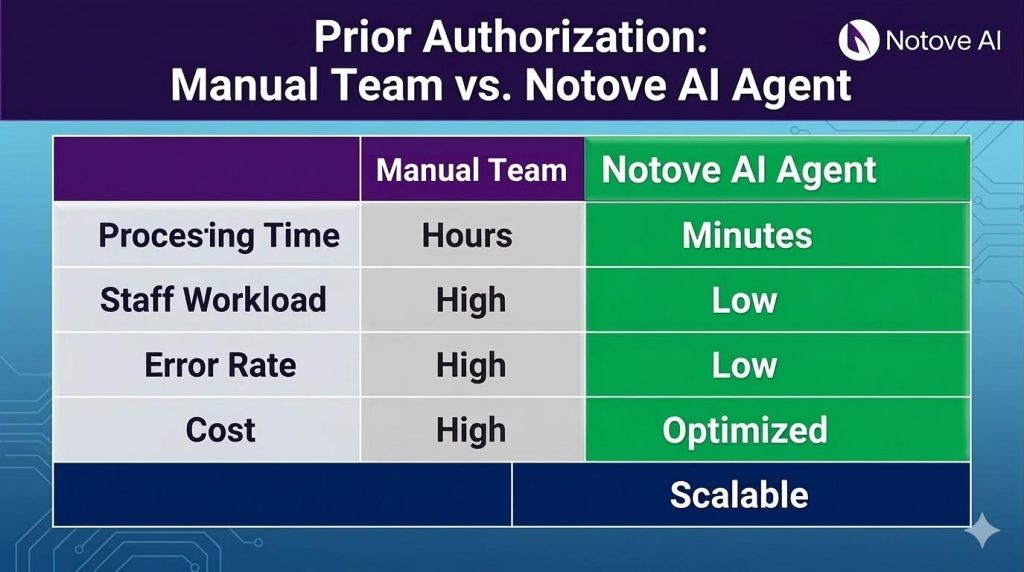
Here is a comparison of the two approaches.
Processing Time
Traditional prior authorization teams may spend 30 minutes to several hours completing a single request.
AI agents can process requests in minutes by automating documentation preparation and submission.
This dramatically improves turnaround time for clinics and patients.
Staff Workload
Administrative staff often juggle dozens of authorization requests at once.
By introducing healthcare administration automation, AI agents eliminate many of the repetitive tasks involved in prior authorization.
This allows staff to focus on higher-value work such as patient coordination and care support.
Error Rate
Manual processes are prone to errors such as:
- missing documentation
- incorrect codes
- incomplete submissions
These mistakes frequently lead to claim denials.
AI systems reduce these risks by standardizing documentation and automatically verifying payer requirements before submission
Cost and Scalability
Hiring additional staff is the only way traditional teams can scale.
However, staffing costs continue to rise across healthcare administration.
AI-powered prior authorization software offers a scalable solution that can process large volumes of requests without increasing headcount.
Benefits of AI for Prior Authorization
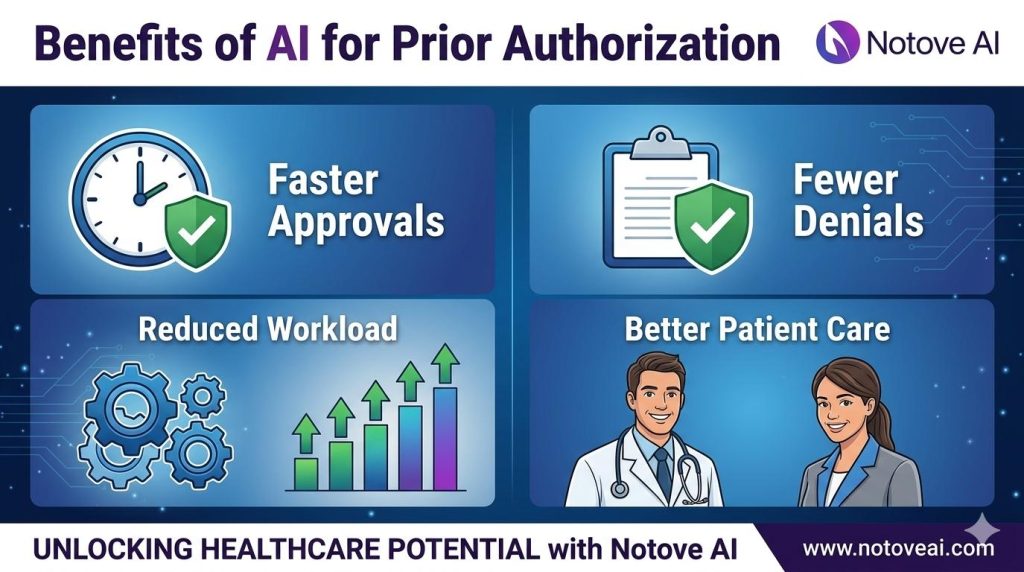
Clinics adopting AI-driven clinic workflow automation are seeing measurable improvements in operational efficiency.
Reduced Administrative Burden
AI agents handle time-consuming tasks such as documentation preparation and form submission.
Faster Authorization Approvals
Automated workflows accelerate the submission process and reduce delays.
Lower Denial Rates
Standardized documentation improves accuracy and reduces resubmissions.
Improved Staff Productivity
Administrative staff spend less time on repetitive tasks.
Better Patient Experience
Faster approvals mean patients receive care sooner.
The Future of Healthcare Administration Automation
Healthcare is undergoing a major shift toward automation.
Administrative complexity has increased dramatically in recent years, and manual processes are no longer sustainable.
AI agents are now being used to automate multiple administrative workflows including:
- prior authorizations
- eligibility verification
- claims processing
- documentation management
As AI for prior authorization continues to evolve, we are moving toward a future where many administrative processes operate autonomously within the EHR.
This shift represents one of the most important advancements in healthcare administration automation.
Why Clinics Are Adopting Prior Authorization Software Like Notove AI
The demand for prior authorization software is increasing rapidly because clinics need solutions that can:
- reduce administrative workload
- accelerate approvals
- improve operational efficiency
- scale without hiring additional staff
AI-powered systems deliver these benefits by transforming the way clinics manage payer requirements and documentation workflows.
For healthcare providers, adopting automation is becoming less of an option and more of a necessity.
Conclusion
Traditional prior authorization teams have long been responsible for managing one of healthcare’s most complex administrative tasks.
But the manual approach is slow, costly, and difficult to scale.
AI-powered prior authorization automation introduces a smarter alternative.
By leveraging AI for prior authorization, clinics can automate documentation preparation, payer submissions, and status tracking — dramatically improving efficiency while reducing administrative burden.
As healthcare organizations continue to adopt clinic workflow automation, AI agents are poised to become an essential part of modern healthcare operations.
In short:
AI agents are not replacing healthcare teams — they are empowering them.
By eliminating repetitive administrative tasks, AI allows healthcare professionals to focus on what matters most: delivering patient care.
Share Post:
Be First to Try Notove
Join the waitlist and get early access, updates, and exclusive onboarding support.