
How EHR Systems Are Contributing to Physician Burnout
EHR systems were sold to the medical community as the fix for fragmented, paper-based care, but for a significant number of physicians in private practice and small clinics, they have become one of the single biggest drivers of professional exhaustion. This is not a complaint from people who are bad at technology, and it is not a generational resistance to change. It is a documented pattern playing out in exam rooms, urgent care centers, and outpatient clinics across the country, where the time a physician spends interacting with a screen has quietly come to rival, or in some cases exceed, the time they spend with patients.
Physician burnout is characterized by emotional exhaustion, a growing sense of detachment from patients and colleagues, and a reduced feeling that the work actually matters. Those are not abstract feelings. They translate directly into care outcomes: shorter visits, missed signals, higher turnover, and patients who sense that something is off even when they cannot name it. Before pointing fingers at any individual or team, it is worth being specific about what part of the system is creating friction. This article focuses on one piece of that puzzle: how EHR workflows and documentation requirements are contributing to burnout, and what can realistically be done about it.
What EHR Systems Are Supposed to Do vs. What Happens in Practice
The original promise of the electronic health record was straightforward: replace paper charts, reduce errors, improve coordination, and make the clinical picture of a patient available to everyone who needs it. On paper, that promise still holds. EHR systems support e-prescribing, clinical decision support, lab result management, and billing. They are designed to create a longitudinal record that follows a patient across providers and settings.
What adoption actually layered on top of that core function is where things get complicated. Today’s EHR environment requires documentation that satisfies billing audits, quality reporting programs, compliance reviews, and patient portal expectations simultaneously. The result is a clinician who spends a meaningful portion of every workday writing notes not for clinical clarity but for an audience of coders, auditors, and regulators. That gap between intent and reality is where “pajama time” was born: the after-hours charting that has become so normalized in medicine that many physicians simply factor it into their schedule as a given.
The 7 Most Common Ways EHR Systems Contribute to Physician Burnout
Not every EHR experience is equally painful, and the same platform can feel very different depending on how it was implemented and maintained. But patterns repeat across specialties and settings. Here are the ones that show up most consistently.
1. Documentation Overload
The modern clinical note has ballooned. A significant portion of what appears in a note today serves billing requirements rather than clinical communication. Templated reviews of systems, copy-forward content from previous visits, and lengthy auto-populated exam sections create documents that are long but informationally thin. Physicians describe the experience as writing for an auditor rather than a colleague, and that distinction matters because it carries real moral weight. Doing work that feels disconnected from patient care, under time pressure, at scale, is a specific kind of drain that is hard to train around.
2. Inbox and In-Basket Overload
The EHR inbox does not close at 5pm. Lab results, medication refill requests, prior authorization documentation, portal messages from patients, inter-clinician tasks, and system-generated alerts stack up continuously. Without a well-designed team-based workflow to triage and route these items, they land on the physician. The volume alone is taxing. The context-switching required to move between a patient interaction and an inbox item compounds that tax. In smaller practices without dedicated support staff, this often means physicians handling work in the evenings and on weekends that could be managed through protocols and standing orders during the day.
3. Poor Usability and Click Fatigue
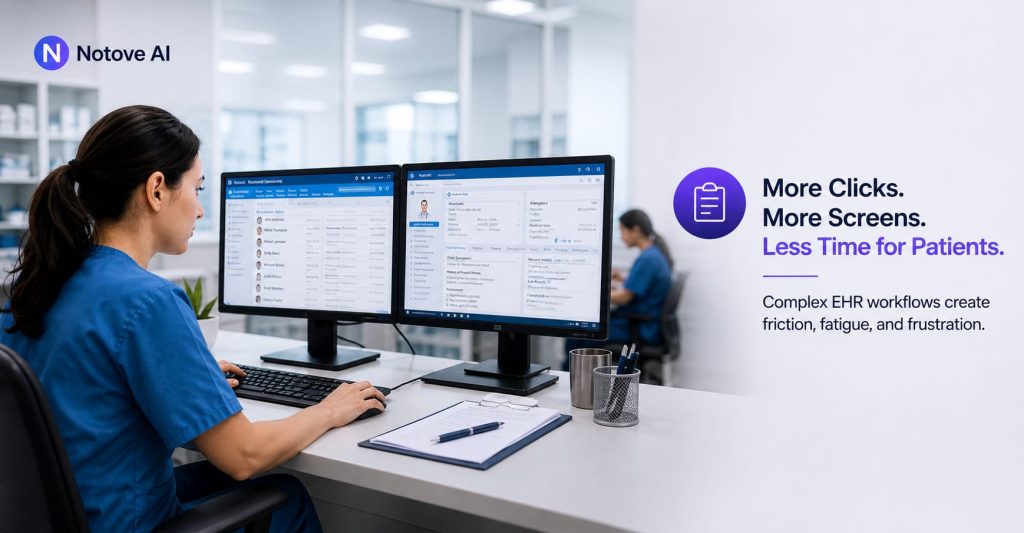
The number of clicks required to complete a basic task in many EHR systems is not trivial. Ordering a medication, sending a referral, reviewing imaging results, and documenting a visit can each require navigating through multiple screens, confirming redundant fields, and re-entering information the system already has. Each individual step is small. Across a full day of patient care, those steps accumulate into something that genuinely affects cognitive performance and morale. Clinicians find themselves remembering where things live in the software rather than thinking about the patient.
4. Alert Fatigue
Clinical decision support alerts exist for good reasons. Drug interaction warnings, health maintenance reminders, and sepsis flags are designed to catch things. The problem is volume and relevance. When a system generates alerts for a large proportion of patient interactions, clinicians begin overriding them reflexively. The signal gets buried in noise. This creates a downstream risk: the one alert that actually matters may not receive the attention it warrants because the clinician has been conditioned to click past. Poorly tuned alerts, vendor defaults not optimized for a specific specialty or setting, and a lack of local governance around alert rules are common root causes.
5. Workflow Misalignment
Some of the administrative tasks that land on physicians have nothing to do with clinical judgment and everything to do with an EHR that does not route work effectively. Manual data entry for quality measures, chasing faxed records, prior authorization paperwork that requires physician-level documentation for tasks that protocols could cover, and medication reconciliation done without support are all examples. When a physician routinely handles tasks that a well-structured team workflow could manage, it creates a sense of role overload that is difficult to shake even when the individual tasks seem minor.
6. Interoperability Gaps
In 2026, it is still common for a physician to receive a patient’s outside records as a PDF dump rather than discrete, structured data. That means manual reconciliation of medication lists, problem lists, and diagnostic history. It means ordering tests that may have already been done elsewhere because the results are not reliably available. It adds cognitive load and introduces clinical risk. The fragmented vendor landscape and inconsistent implementation of interoperability standards have made genuine data sharing harder than it should be, and the burden of that failure tends to fall on the clinical staff who have to fill the gaps by hand.
7. Loss of Autonomy Through Surveillance
Productivity dashboards, note timing audits, mandatory template fields, hard stops, and documentation compliance scores create an environment where physicians feel monitored rather than supported. There is a meaningful difference between using data to understand a system and using data to pressure clinicians into hitting targets. When measurement feels punitive rather than transparent, it erodes trust in the institution and contributes to the sense that professional judgment has been displaced by metric optimization.

How Delays Translate Into Worse Outcomes
There are six reasonably direct pathways from a PA delay to clinical harm.
The first is disease progression. When a patient is waiting for approval, their condition does not pause. Inflammatory conditions flare. Tumors progress. Infections advance. Every day without treatment is a day the disease is running without resistance.
The second is missed diagnostic windows. A delayed MRI or lab panel can push a diagnosis into a later and less treatable stage. The decision to image was made at the right time. The image just never happened when it should have.
The third is therapy interruption. Stopping and restarting a medication is not the same as never starting it. For some treatments, consistency is the mechanism of action. Interruptions reduce efficacy and, in some cases like certain psychiatric or antiretroviral medications, increase resistance risk.
The fourth is substitution with inferior options. Step therapy forces patients onto less effective treatments first. A patient who needs a biologic ends up on an NSAID. A patient who cannot tolerate a first-line medication must fail it formally before a better option is approved.
The fifth is avoidable emergency department visits and hospitalizations. When outpatient care is blocked, conditions escalate. A patient who could not get a covered infusion appointment ends up in the ED. That visit is more expensive, more traumatic, and more resource-intensive than the outpatient care that was delayed.
The sixth is treatment abandonment. Many patients simply stop pursuing care when the approval process becomes overwhelming. The complexity, the phone calls, the re-submissions, and the uncertainty are enough to cause some patients to give up entirely.
What the Evidence Shows
The professional and research consensus on this is consistent. The American Medical Association has surveyed physicians annually on PA and found, year after year, that the majority report that PA has caused delays in care, and a significant portion report it has led to serious adverse events for their patients.
Studies tracking overturned denials are particularly telling. When PA denials are appealed and reversed, it means the original denial was incorrect. But the reversal does not undo the delay. A patient whose approval was held for three weeks while an appeal worked its way through review still waited three weeks. The clinical damage from that window is not recovered just because the final answer was yes.
CMS audits of Medicare Advantage plans have found cases where prior authorization was used to deny care that met coverage criteria. GAO reports have documented widespread inconsistency in how criteria are applied across plans and geographic regions.
The pattern is consistent enough that most major specialty societies including oncology, cardiology, rheumatology, and psychiatry organizations have published formal position statements calling for PA reform.
Who Gets Hit Hardest
The burden of PA delays is not evenly distributed. Some patients are hit far harder than others.
Patients with complex chronic conditions face more PA touchpoints. Someone managing an autoimmune condition with a biologic, a comorbid mood disorder, and recurring imaging requirements may encounter PA requirements multiple times per month across different services and payers.
Cancer and autoimmune patients on specialty drugs face some of the highest denial rates and longest review timelines. For these patients, delays measured in weeks can change how a disease responds to treatment.
Mental health patients are particularly vulnerable to therapy interruptions. A forced medication switch due to step therapy, or a re-authorization delay, can cause a relapse that disrupts employment, housing stability, and family relationships.
Pediatric and rare disease patients often have no alternative options. Denying or delaying the one approved therapy for a rare condition is functionally a denial of all treatment.
Rural and underserved patients are least equipped to absorb delays. Smaller clinic staff means fewer people available to navigate appeals. Limited specialty access means that if a referral is delayed, there is no nearby substitute. Language barriers, low health literacy, and unstable phone access all make the appeals process harder to complete.
The table below summarizes how the harm profile differs across patient populations.
How This Shows Up in Patient Care and Practice Operations
The downstream effects of EHR-driven burnout are not contained to the physician experience. Patients notice shorter visits. They notice less eye contact. They see a provider who is visibly managing a screen. Rushed charting creates documentation that no one trusts. Copied notes obscure clinical changes. Inbox items handled at 10pm after a long day may not receive the attention they need.
For practices, the math is straightforward: burnout drives turnover. Recruiting and replacing a physician is expensive. Reduced panel capacity, early retirement decisions, and increased reliance on locum coverage are all downstream costs of a problem that started with poor workflow design.
What Is Actually Fixable
It is worth being honest about what is and is not within a practice’s control. Fee-for-service billing requirements drive a large proportion of documentation burden, and no amount of local optimization fully reverses that. But there is still meaningful room to improve within those constraints.
The table below separates common EHR pain points by their root cause and who has leverage to address them:
| Pain Point | Root Cause | Who Can Act |
|---|---|---|
| Note bloat from billing templates | Fee-for-service documentation rules + local build choices | Informatics team + clinical leadership |
| Inbox overflow | No team-based triage protocol | Practice operations and administrators |
| Click fatigue | Poor EHR configuration and lack of optimization | Informatics / IT team |
| Alert fatigue | Vendor defaults not locally tuned | Informatics team |
| Workflow misalignment | Weak delegation protocols | Clinical leadership + operations |
| Interoperability failures | Vendor landscape + data governance | Health system leadership and policy |
| Surveillance pressure | Leadership culture + measurement design | Executive leadership and managers |
Practical Ways to Reduce EHR-Related Burnout
For healthcare leaders, the starting point is measurement. Time spent in the EHR, after-hours usage, inbox volume, and clicks per common workflow are all things that can be tracked and should inform priorities. Creating a clinician-led governance structure for EHR decisions, resourcing the hidden inbox work, and protecting visit time from creeping documentation requirements are all operational changes that do not require switching platforms.
For informatics and IT teams, the most impactful work is often the unglamorous kind: watching real clinicians use the system, mapping the steps required for the ten most common tasks, and removing friction one layer at a time. Alert tuning by specialty and location, cleaner reconciliation workflows, and faster default views make a meaningful cumulative difference.
For physicians and care teams working within an imperfect system, some things help even before broader changes arrive. Scheduling inbox review in defined blocks rather than reacting continuously, using smart phrases and templates intentionally rather than letting them generate note bloat, and defining clear protocols for what nurses or medical assistants can handle are all practical starting points.
On the question of AI and documentation tools: ambient documentation has real potential to reduce typing burden and return attention to the patient conversation. The evaluation criteria that matter are accuracy, how well the output integrates with the existing EHR, patient consent processes, and whether the tool genuinely reduces documentation time or just shifts it into an editing task.
What “Good” Looks Like
A well-functioning EHR environment has some recognizable characteristics. Notes are short enough to actually read and clinically useful. Inbox work is distributed, triaged, and does not routinely continue into the evening. Alerts are trusted because they are relevant and infrequent enough to warrant attention. Clinicians can find what they need quickly, whether that is a trend in lab values, a consult note, or a current medication list. And optimization is treated as an ongoing function rather than a one-time go-live project.
None of this requires a different platform. Many of the most painful EHR environments run on the same software as some of the least painful ones. The difference is almost always in governance, workflow design, staffing, and whether the institution treats clinician experience as a thing that warrants the same attention as billing performance.
Take Back Your Time with Notove
If you are a physician or practice administrator looking for a practical place to start, Notove was built specifically for this problem. It is a browser-based AI tool designed for private practices and small clinics, focused on the administrative tasks that eat into your clinical day: prior authorizations, letters of medical necessity, referral notes, pre-charting, and routine form completion. No installation, no IT team required, and no disruption to your existing EHR setup. Visit notove.com to learn more and join the waitlist.
Frequently Asked Questions
What is the connection between EHR systems and physician burnout?
EHR systems contribute to physician burnout primarily through documentation overload, inbox management demands, poor usability, and workflow misalignment. When physicians spend more time managing an EHR interface than engaging with patients, the emotional and cognitive cost accumulates into the exhaustion and cynicism that define burnout.
Can physician burnout be reduced without replacing the EHR?
Yes, and this is an important point. The same EHR platform can be implemented in ways that minimize or significantly worsen clinician burden. Local governance, workflow design, team-based triage protocols, alert tuning, and optimized order sets can all reduce burnout without a platform change.
What is alert fatigue and why does it matter for patient safety?
Alert fatigue occurs when a high volume of clinical decision support notifications desensitizes clinicians to the point that they begin overriding alerts without reviewing them carefully. This matters for patient safety because the alerts designed to catch meaningful risks, such as a serious drug interaction, may receive the same reflexive override as a low-value reminder.
What does “pajama time” mean in the context of EHR use?
Pajama time is a term used in clinical settings to describe the after-hours charting and inbox management that physicians routinely complete at home in the evenings or on weekends. It reflects how EHR documentation demands regularly extend well beyond the scheduled workday.
What is the difference between a note bloat problem and a billing requirement problem?
Note bloat is often partially driven by fee-for-service billing documentation requirements, but not entirely. Local implementation choices, copy-forward culture, and a lack of documentation governance also contribute. Some of what appears in an inflated note reflects compliance requirements that cannot easily be removed. But a meaningful portion reflects defaults and habits that can be changed at the practice level.
How can smaller practices reduce EHR administrative burden without a large IT team?
Smaller practices have fewer resources but also more agility. Practical steps include defining clear protocols for what clinical staff can handle without physician involvement, using smart phrases and templates to reduce repetitive typing, scheduling inbox time in focused blocks rather than responding reactively, and adopting purpose-built AI tools that handle specific administrative tasks without requiring deep EHR integration.
Share Post:
Be First to Try Notove
Join the waitlist and get early access, updates, and exclusive onboarding support.