
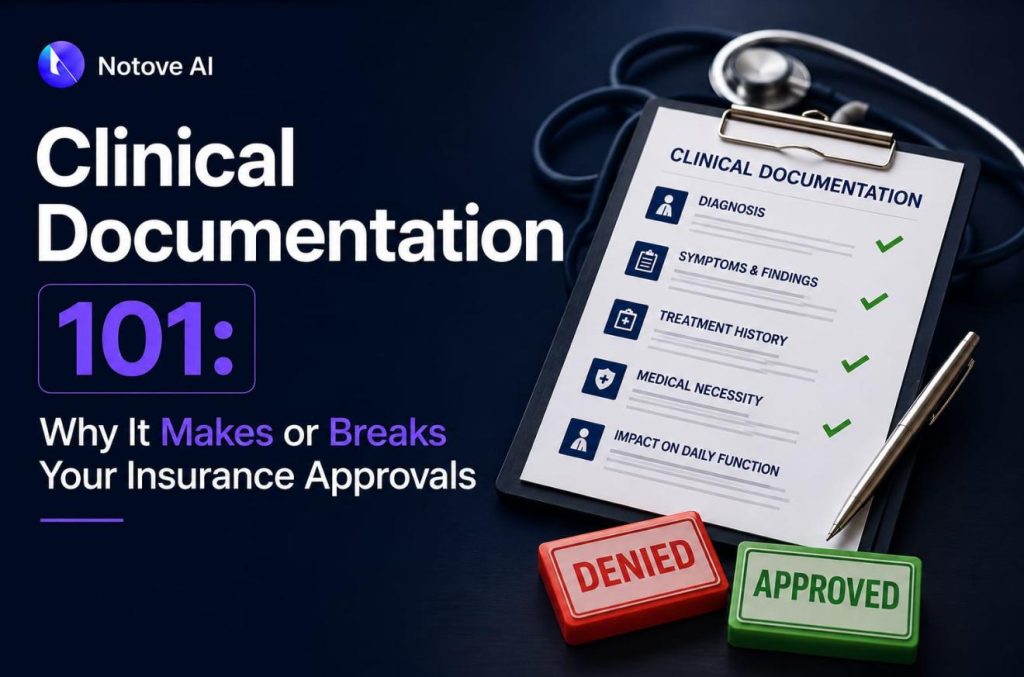
Clinical Documentation 101: Why It Makes or Breaks Your Insurance Approvals
Clinical documentation is the difference between a claim that sails through and one that stalls for weeks while your patient sits in limbo. If you have worked in behavioral health or any specialty that deals with payer review, you already know this feeling: the care plan is solid, the clinical reasoning is there, the patient clearly needs this level of care, and yet the prior authorization or continued stay request comes back denied. Not because the care was wrong. Because the note did not prove it in the way a reviewer could act on it.
This article covers documentation that supports insurance approvals: prior authorizations, continued stay reviews, claims, and audits. It is written for clinicians, care teams, and anyone involved in treatment planning, utilization review, or payer-facing documentation in behavioral health and healthcare operations. Nothing here is legal advice, and you should always follow your payer, state, and facility policies. What this is, is practical guidance on how to close the gap between clinical quality and payer sufficiency.
What Insurers Actually Look for (And Why “Good Notes” Still Get Denied)
Payers do not read your notes the way a clinical supervisor does. They are looking for coverage criteria, and they are looking fast. A compassionate narrative about a patient’s struggles is not the same thing as a defensible medical necessity argument, even if it tells a better story.
Coverage decisions are evidence-based and criteria-driven. Reviewers are checking for a specific set of signals: diagnosis, severity, risk, functional impairment, skilled need, and treatment response. When any of those pieces are absent or vague, the decision defaults to denial.
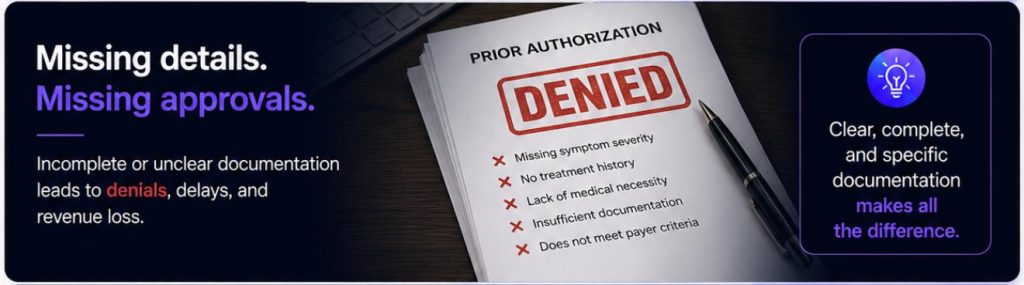
The most common disconnects that trigger denials are not clinical failures. They are documentation failures. A diagnosis that does not match the symptoms described in the assessment. Goals so broad they cannot be measured. No documented objective change between review periods. Risk documented on admission and then never mentioned again. A discharge plan that does not exist. These are the gaps that reviewers find, and they find them every time.
Clinical Documentation 101: The Non-Negotiables
Clinical documentation in this context is a legal record, a clinical record, and a reimbursement record all at once. Most payers expect to see the following components consistently across the chart: presenting problem, diagnosis support, risk, functional impact, treatment plan, skilled interventions, treatment response, ongoing need, and discharge or step-down planning.
That last word, consistently, matters more than most teams realize. A thorough intake assessment means nothing if the daily progress notes describe a different patient. The assessment, the plan, the notes, the utilization review summaries, and the discharge summary all need to tell the same story with the same facts.
Medical Necessity: How to Document It So a Reviewer Cannot Miss It
Medical necessity answers three questions in plain language: why this level of care, why now, and why for this patient specifically. Reviewers are asking the same three questions in a slightly different form: Is the problem covered? Is the level of care appropriate? Is there evidence it is working and still needed?
To answer those questions clearly, your documentation needs to include severity, acuity, risk, functional impairment, history of failed lower levels of care, why the current intensity or structure is required, and a clinical rationale tied to individualized goals. Not boilerplate. Not a template dropped in unchanged from the last patient. The clinical rationale needs to reflect this person’s presentation.
Objective Evidence: Turning Symptoms Into Reviewable Proof
Payers prefer observable, quantifiable detail over subjective clinical impressions. That does not mean your clinical judgment does not matter. It means your clinical judgment needs to be shown, not just stated.
Objective documentation looks like this: frequency, duration, and intensity of symptoms; sleep and appetite changes; attendance and participation; functioning in daily activities, work, or school; withdrawal scales or vitals where applicable; and standardized measures when they are being used. Documenting a trend over time, from baseline to current status and the delta in between, tied directly to your interventions, is what builds a reviewable case for ongoing care.
The phrase “doing well” without any metrics is one of the fastest ways to trigger a denial. Show what changed, and show what is still impaired.
Risk and Safety: Document Like It Matters
Risk documentation directly supports level-of-care decisions and continued stay justifications. What to include: suicidal and homicidal ideation, self-harm behaviors, psychosis or mania, intoxication or withdrawal risk, domestic violence or environmental safety concerns, and inability to adequately care for oneself.
Beyond listing risks, document protective factors, assign a risk level with your rationale, and connect that risk level to the safety plan elements you have in place. One common pitfall that reviewers notice immediately: risk is documented thoroughly on day one and then disappears from the notes for a week. Continuity of risk documentation is not optional. It is what keeps a continued stay review from falling apart.
Goals, Interventions, Response: The Care Loop That Drives Continued Stay
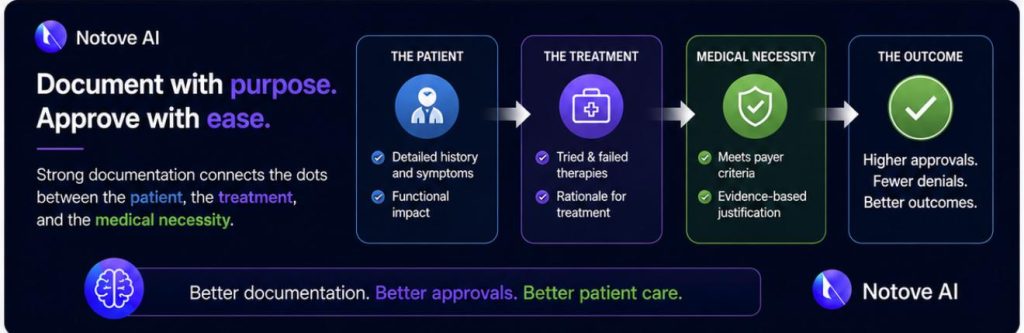
The logic reviewers follow is a loop: problem leads to goal, goal leads to intervention, intervention leads to patient response, response leads to the next plan. If any link in that chain is broken or missing, the case for continued stay weakens.
Goals need to be specific and measurable. “Reduce anxiety” is not a goal a reviewer can evaluate. “Patient will identify and use two coping strategies when anxiety exceeds a self-rated 7/10, three times per week” gives a reviewer something to look for. Document what the clinician actually did as a skilled intervention, not just that a session occurred. And capture the response: what is working, what is not, and what changed in the plan as a result.
Where Approvals Fail Most Often: 8 Documentation Mistakes That Trigger Denials
| Mistake | Why It Causes a Denial |
|---|---|
| Vague language (“stable,” “improving”) with no evidence | Reviewers cannot confirm necessity without measurable support |
| Copy/paste notes that do not reflect today’s presentation | Signals that the note does not represent actual care delivered |
| Diagnosis does not match symptoms in the assessment | Creates a credibility gap that reviewers flag immediately |
| No functional impairment documented | Functional impairment is a core medical necessity criterion |
| Missing or inconsistent risk documentation | Undermines level-of-care justification across the review period |
| Treatment plan not updated; goals not measurable | Suggests care is not active or individualized |
| No documented failure of lower level of care | Payers need a reason the current intensity is necessary |
| No clear discharge or step-down plan | Reviewers want trajectory, not an indefinite open-ended stay |
Prior Authorizations vs. Continued Stay vs. Claims: Document for the Decision You Are Asking For
Different approval moments require different emphasis. An initial prior authorization, a continued stay review, and a claims audit are not the same request with the same documentation needs. Treating them that way is a reliable path to unnecessary denials.
A useful mindset here is the “approval packet”: every payer interaction should be supported by a complete picture, including your assessment, treatment plan, recent progress notes, outcome measures, and a utilization review summary. When this information is scattered across the chart, delays follow.
Initial Authorization: Proving You Chose the Right Level of Care on Day One
For initial authorizations, foreground the presenting symptoms, acuity, risk, functional impairment, relevant history, recent decompensation, and why lower levels of care are not sufficient. Tie the diagnosis directly to the current presentation with specific examples, not just DSM criteria. Document the immediate plan: frequency of services, modalities being used, safety measures in place, and measurable goals.
Continued Stay: Showing Progress and Ongoing Need
This is where most teams struggle. Progress and ongoing need are not opposites, but the documentation has to hold both at once. “Improving, but risk and functional impairment persist” needs to be followed by specifics. Document barriers to discharge and what the team is actively doing about them. Show that treatment is alive: plan changes, consultations, family involvement, coordination of care. Include a clear next-step plan and what the discharge criteria look like.
Claims and Audits: Making Sure the Story Matches the Codes
Services billed must be supported by documented time, modality, and medical necessity. Diagnosis, level of care, and interventions need to be consistent across every document in the chart. Common audit red flags include cloned notes, missing signatures or credentials, late entries with no explanation, and services billed that the documentation does not actually support.
A Simple, Repeatable Documentation Workflow
The goal is not robotic documentation. It is standardized quality so that approvals do not depend on whichever clinician happens to write well that week. A workable workflow follows this sequence: intake and assessment, treatment plan, daily or weekly progress notes, utilization review summary, and discharge summary.
Templates are guardrails, not scripts. The individualized clinical reasoning still has to be there.
The “5-Line Medical Necessity” Snippet
A reusable structure that can be dropped into any key note: current severity and functional impairment; risk level with rationale; skilled services provided or needed; response to treatment and current barriers; and why the current level of care remains necessary along with the next steps. Tailor the language to the patient’s actual presentation and the relevant payer’s known expectations.
Team Alignment: Clinicians and UR on the Same Page
Clinicians document the clinical picture. Utilization review synthesizes it for payers. Both need to be working from the same facts. A shared checklist for each review cycle covering risk, function, progress, plan, and discharge readiness reduces the back-and-forth that happens when UR has to go hunting for information that should have been in the note the first time.
Tools and Systems That Make Documentation Easier
EHR templates with structured fields for risk and functional status, integrated outcome measures, and AI-assisted drafting tools can all reduce the manual burden on documentation. If your team uses AI drafting tools, build in required human review for accuracy and patient privacy before anything goes out the door. Version control and clean audit trails matter, especially when a claim is challenged months later.
Compliance Essentials: Accurate, Timely, and Defensible Notes
Document contemporaneously. If there is a late entry, note it as such and explain why per your facility’s policy. Do not copy forward without updating. Every note needs to reflect that specific date’s clinical reality. At a minimum, every note needs credentials, signatures, patient identifiers, and coordination-of-care documentation where applicable. Keep language clinically appropriate and free of judgmental phrasing.
The Documentation Standard That Gets Approvals Consistently
Approvals follow clarity. Severity, risk, functional impairment, skilled need, treatment response, and a forward-looking plan: these are the building blocks of every successful approval interaction. Pick one template or checklist this week, implement it, and then pull five charts and audit them against the eight common mistakes listed above. That single exercise will show you exactly where your team’s documentation is leaving approvals on the table.
If your practice is still managing prior authorizations manually and chasing documentation across the chart every time a review comes up, Notove was built for exactly that problem. Visit notove.com to see how AI-assisted prior authorization workflows can take the administrative weight off your clinical team and reduce denials at the same time.
Frequently Asked Questions
What is the most common reason clinical documentation leads to a denied prior authorization?
The single most common reason is vague language that does not demonstrate medical necessity. Phrases like “patient is stable” or “continues to need treatment” without objective evidence of severity, functional impairment, or risk give reviewers nothing concrete to approve. Medical necessity has to be shown, not just stated.
How often should risk and safety be documented during a continued stay review period?
Risk should be documented consistently throughout the entire review period, not just on admission or at the point of the review. If risk is noted on day one and absent for the following week, reviewers will notice the gap and may question whether the level of care is still justified. Every clinical note during an active authorization period should include at least a brief, current risk statement.
What is the difference between clinical quality and payer sufficiency in documentation?
Clinical quality refers to how well a note reflects the actual care delivered and the clinician’s reasoning. Payer sufficiency refers to whether that note contains the specific elements a reviewer needs to make a coverage decision. A note can be clinically thorough and still be payer-insufficient if it lacks measurable goals, objective functional data, or a clear rationale for the current level of care.
Do treatment goals really need to be measurable, or is that just a best practice suggestion?
They genuinely need to be measurable if you want to support continued stay reviews. Reviewers are looking for evidence that treatment is working and that there is a defined endpoint. A goal that cannot be measured cannot demonstrate progress, which means it cannot demonstrate that continued care is producing results worth authorizing.
What should a “discharge plan” include to satisfy payer requirements during a continued stay review?
It should include the criteria that need to be met before the patient can step down, what the next level of care will be, what barriers currently prevent discharge, and what the team is actively doing to address those barriers. Reviewers do not want to see open-ended stays without a trajectory. A discharge plan does not mean discharge is imminent; it means care has a direction.
Share Post:
Be First to Try Notove
Join the waitlist and get early access, updates, and exclusive onboarding support.