
HIPAA-Compliant Prior Authorization Automation: What to Look For in a Vendor
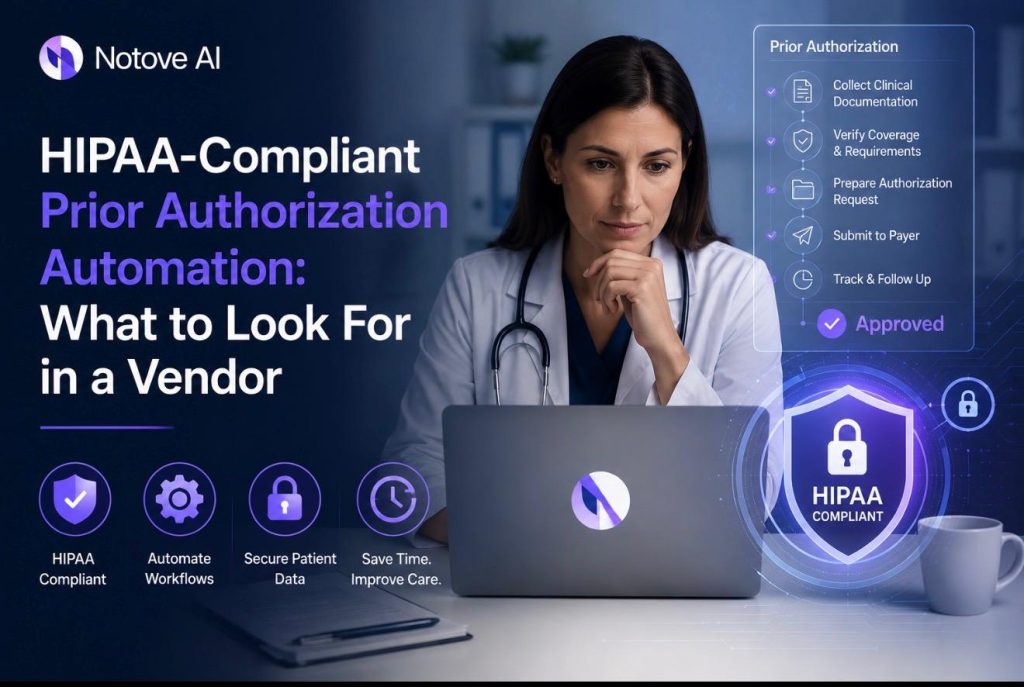
HIPAA-Compliant Prior Authorization Automation: What to Look For in a Vendor HIPAA-Compliant Prior Authorization is no longer a nice-to-have for clinics that automate their workflows. It is the baseline requirement before any vendor conversation should even start. Prior authorization already eats up hours every week. Add a tool that mishandles patient data, and you have traded one problem for a bigger one. Patients wait longer for care when authorization gets stuck. Revenue cycle teams fall behind on claims. Staff burn out from chasing payer portals. And every one of these issues gets worse if the automation tool itself creates audit exposure. Most tools on the market fall short in one of a few ways. Some are generic automation scripts wearing an AI label. Some have a weak security posture that would not survive a real audit. Others ignore payer-specific logic entirely. Many skip human review altogether, which is a risk nobody in healthcare should accept. This guide breaks down what a real HIPAA-Compliant Prior Authorization vendor should offer, and how to evaluate one without getting lost in sales language. Prior Authorization Automation, Explained in Plain English Prior authorization is the approval a payer requires before it will cover a procedure, medication, or imaging order. Automation touches this process at three points: before submission, during submission, and after submission. There is a real difference between a macro, a workflow tool, and an AI agent. A macro just fills in a template. A workflow tool moves a task from one queue to another. An AI agent reads context, pulls clinical evidence, and drafts a payer-specific request. A typical prior authorization workflow looks like this. Staff identify that a procedure needs authorization. They gather supporting evidence from the chart. They complete the payer’s form or portal. They submit it, track it, and respond to any follow-up requests or appeals. Good automation shortens every one of these steps. It reduces the number of times a human has to touch the same request. It prevents missing information before it becomes a denial. It shortens turnaround time and keeps the process consistent across staff members. HIPAA Basics Vendors Must Meet, Without the Legalese Any vendor that creates, receives, stores, or transmits patient data on a clinic’s behalf is a HIPAA Business Associate. That means a signed Business Associate Agreement is not optional. If a vendor hesitates on this point, that alone should end the conversation. The HIPAA Privacy Rule governs how patient data can be used and shared. The Security Rule governs how that data is protected technically and physically. A HIPAA-Compliant Prior Authorization tool needs to satisfy both, not just one. The Minimum Necessary standard matters here too. Automation should only pull the data required for that specific request. Role-based access and scoped data retrieval keep exposure limited if something goes wrong. Think through the full data lifecycle. Collection, processing, storage, transmission, retention, and deletion all carry separate risks. A vendor should have a clear answer for each stage, not a vague one-line policy. The Vendor Evaluation Checklist: What to Look For This is the core of any buying decision. Build an internal scorecard before you take a single sales call. Score each vendor across compliance, security, workflow fit, outcomes, implementation, and support. Ask for documentation at every step. Policies, audit reports, and security overviews should be available in writing. Confirm every verbal answer actually appears in the contract or the BAA itself. The table below is a simple scorecard you can use during vendor calls. Score each category from one to five and total it at the end. Evaluation Category What to Verify Weight BAA and HIPAA readiness Signed BAA, breach notification terms, subcontractor coverage High Security controls Encryption, MFA, RBAC, audit logs, SOC 2 status High AI safety Human review, source-grounded extraction, no PHI used for training High Workflow fit Specialty support, exception handling, task routing Medium Documentation assembly Payer-specific packets, validation checks, version control Medium Submission tracking Status visibility, follow-up reminders, denial capture Medium EHR compatibility Integration depth, data mapping, duplicate work prevention Medium Reporting Turnaround time, denial rate, compliance logs Low Implementation and support Onboarding timeline, training, SLA response times Low Pricing and contract terms Ownership, exit plan, hidden costs Low 1. HIPAA Readiness: BAA, Policies, and Accountability Confirm the vendor will sign a BAA before anything else. Ask them to define permitted uses and disclosures in plain terms. Find out who acts as their Security and Privacy Officer equivalent. Ask how they handle incidents when something goes wrong. Ask about workforce training, access reviews, and sanction policies on their end. The contract needs to cover subcontractors and set clear breach notification timelines. 2. Security Controls That Actually Protect PHI Encryption in transit and at rest is table stakes. Ask how they manage encryption keys, not just whether encryption exists. Access controls should include SSO, MFA, role-based permissions, and session timeouts. Audit logs need to capture user actions, document access, and exports. Ask how long logs are retained and whether you can export them yourself. Look for third-party assurance such as SOC 2 Type II or a recent penetration test summary. 3. AI Safety and Compliance: How the Model Touches Patient Data Ask exactly where AI touches the workflow. Is it extracting clinical evidence, drafting letters, or filling payer-specific forms? Each of these carries different risk levels. Human-in-the-loop review before submission is not optional in a clinical setting. Confirm patient data is never used to train public models. Ask about hallucination controls, like requiring citations from the actual chart entry. Explainability matters for audits. A HIPAA-Compliant Prior Authorization tool should show exactly which note, date, and section supported each claim. That transparency protects the clinic if a payer or auditor pushes back later. 4. Workflow Fit: Does It Match How Clinics Actually Work? Specialty clinics have different documentation needs than primary care. Radiology, orthopedics, cardiology, and oncology all face different payer rules. A good vendor should already understand these differences. Ask how the tool handles missing data or unclear documentation.