

The Hidden Cost of Manual Prior Authorization in Radiology Practices
Manual Prior Authorization is costing your radiology practice far more than you realize, and most of it never shows up as a single line item anywhere in your financials. It hides in payroll, in scanner downtime, in the patient who got tired of waiting and booked somewhere else, and in the authorization specialist who quietly started looking for a new job three months ago. This article breaks down where those costs actually live, how to find them in your own operation, and what you can do about it before they compound further.
What “Manual Prior Authorization” Actually Looks Like in Radiology
Before talking about costs, it helps to be specific about what manual prior authorization means in practice. It is not a single task. It is a chain of human-driven steps: verifying benefits and eligibility, gathering clinical documentation from the referring provider, looking up payer-specific criteria, submitting through a portal or by fax or by phone (sometimes all three for the same case), scheduling a peer-to-peer if the payer pushes back, checking status repeatedly, documenting the outcome, and finally releasing the appointment to scheduling.
For advanced imaging, the chain gets longer. CT, MRI, and PET scans often go through radiology benefit managers like eviCore or NIA rather than directly to the payer. Each RBM has its own portal, its own clinical criteria, and its own timeline. A case that starts with a fax might end with a peer-to-peer call three days later. And if the clinical note from the ordering physician was incomplete when it arrived, the whole process stalls and restarts.
The word “manual” matters because it means a person is doing each of those steps, across every case, every day, while the phone is also ringing and the portal is also timing out.
The Hidden Costs: Where It Hits Your Practice
1. Direct Labor: The Authorization Shadow Workforce
The most immediate cost is the staff time being consumed. Schedulers, PA specialists, clinical reviewers, billing staff, and occasionally radiologists for peer-to-peer calls are all part of the authorization ecosystem. Most practices have never added up what that actually costs.
A simple framework: multiply your average minutes per case by your blended hourly rate across roles involved, then by your monthly authorization volume. Even at a conservative estimate of 20 minutes per case for routine submissions and a blended rate of $25 per hour, a practice processing 400 authorizations a month is spending around $3,300 in direct labor just on the submission step. Add status checks, rework, and peer-to-peer prep, and that number climbs fast.
What compounds this is the interruption cost. Every time a staff member stops to log into a different portal, chase a missing clinical note, or wait on hold with an insurance company, they lose their working rhythm on everything else.
2. Revenue Delay: Slower Approvals, Slower Cash
Authorization delay creates a chain reaction that goes straight to your cash flow. No approval means no scheduled scan. No scheduled scan means no charge capture. No charge capture means slower payment, and in the meantime the auth validity window is ticking down.
Payer authorizations typically expire within 90 days, sometimes less. If a case gets approved but scheduling is delayed because of backlog or patient availability, that auth can expire before the scan ever happens. Now the team has to resubmit, restart the clock, and the scanner slot sits open in the meantime.
High-deductible plan patients add another wrinkle. When timing is uncertain, the conversation about patient financial responsibility gets harder to have, and practices often defer it rather than deal with it mid-auth chaos. That deferred conversation becomes a collections problem later.
3. Denials and Rework: Doing the Work Twice
Denial rates tied to authorization issues are not small. Common drivers include medical necessity criteria mismatch, incomplete clinical documentation, CPT and ICD-10 pairing errors, expired authorizations, and site-of-service problems. Each of those is a failure point that a manual workflow is more likely to produce than an assisted one.
When a denial comes in, someone has to investigate the reason, gather additional documentation, coordinate a peer-to-peer if applicable, resubmit, and then follow up again. That is often 45 to 90 minutes of additional work on top of what was already spent. For a practice with a meaningful denial rate, this rework is effectively paying twice for the same case.
4. Capacity Loss: Empty Scanner Slots Nobody Can Fill Last-Minute
Pending authorizations block schedule slots. When an approval comes through unexpectedly, there is rarely a patient ready to fill that slot on short notice. When an authorization falls through at the last minute, the patient gets rescheduled and the time is lost.
The downstream effects reach the whole operation: longer wait times for routine cases, overtime for technologists when urgent add-ons get pushed in, and referring physician frustration when their patients can not get timely appointments. Radiology runs on throughput. Anything that creates irregular scheduling gaps undermines the efficiency the whole revenue model depends on.
5. Patient Leakage: Authorization Friction Sends Patients Elsewhere
Patients are not loyal to imaging centers that are hard to schedule. If the authorization process creates repeated calls, unclear status updates, or last-minute cancellations, a meaningful share of patients will follow their referring physician’s next suggestion to a different facility. They often do not complain. They just do not come back.
Referring offices feel this too. Their staff will gravitate toward imaging centers that give them clean, predictable authorization experiences. If your practice is the one that always needs to call back for more information or keeps cases in limbo for days, you will start losing referrals to competitors who have tightened up their intake process.
6. Compliance and Audit Exposure
Manual authorization processes produce inconsistent documentation. An approval obtained by phone gets logged differently than one obtained through a portal. A fax confirmation gets filed somewhere that is not the same place as the portal screenshot. When an audit comes, or when a payer requests documentation for a claim, the trail is fragmented.
Missing authorization numbers, absent clinical rationale notes, and unclear timestamps are exactly what auditors look for. The financial exposure from takebacks or payer contract disputes is real, and it is entirely avoidable with standardized documentation practices.
7. Burnout and Turnover: The Cost That Takes a Year to Show Up
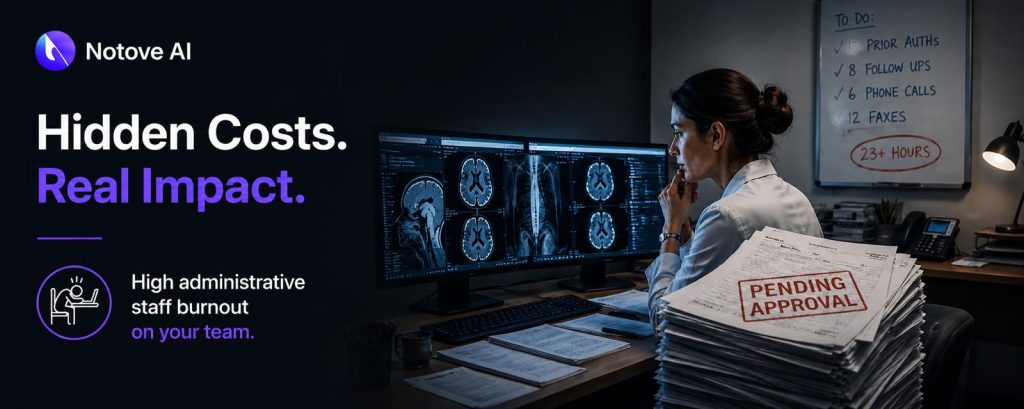
Radiology authorization work is relentless. The same forms, the same portals, the same hold music, the same pushback from payers, every single day. Staff in these roles report high levels of frustration and disengagement, and turnover in authorization-heavy positions is a known problem in healthcare administration.
When an experienced authorization specialist leaves, the practice loses institutional knowledge about payer quirks, portal shortcuts, and documentation habits that took months to accumulate. The new hire starts over, makes more errors, produces more denials, and the cycle continues.
Why Radiology Gets Hit Harder Than Most Specialties
Advanced imaging sits at the intersection of clinical complexity and payer skepticism. Insurers apply stricter criteria to CT, MRI, and PET than to most other services. The documentation requirements are heavier: evidence of prior conservative therapy, red flags, failed treatments, symptom duration. If any of that is missing from the referring provider’s order, the case stalls.
The volume dynamics make it worse. A specialty seeing 30 patients per week might handle 10 authorizations. A busy imaging center might process hundreds. Small inefficiencies in process translate into significant monthly losses when multiplied across that volume.
Common Authorization Failure Points (and What Is Actually Causing Them)
This table maps the symptoms practices usually notice first to the underlying workflow breakdowns producing them. Most of these are fixable once you can name them correctly.
| Symptom You Notice | Root Cause | Where It Breaks Down |
|---|---|---|
| Constant status-check calls from referring offices | No shared tracking system or status visibility | Follow-up and communication |
| High rate of “missing clinicals” at submission | Intake process does not require complete documentation upfront | Order intake |
| Peer-to-peer backlog piling up | No coordinator role owning scheduling; radiologist pulled in reactively | Escalation and scheduling |
| Repeated portal resubmissions for the same case | CPT/ICD-10 mismatch or wrong plan selected on first submission | Submission accuracy |
| Last-minute cancellations due to expired auths | No expiration tracking or alert system | Auth lifecycle management |
| High denial rate from one specific payer | Payer-specific criteria not captured in workflow | Payer rules documentation |
| Staff overtime spikes without volume increases | Context-switching and rework consuming time not reflected in per-case estimates | Labor tracking |
How to Reduce the Burden Without Overhauling Everything at Once
The sequence matters. Standardize before you automate. Automating a broken process just produces errors faster.
Phase one is intake. Create a required-fields checklist by modality and indication. If a CT abdomen order arrives without documentation of prior conservative therapy and the clinical indication, it should not move forward until that information is in hand. Define who is responsible for requesting it and how long they have to get it.
Phase two is tracking. Build or configure a centralized tracker with consistent fields: payer, CPT, ICD-10, submission date, status, auth number, expiration date, and notes. Whether this lives inside your RIS, PM system, or a well-controlled spreadsheet, the point is that anyone on the team can see the current state of any case at any moment without having to ask someone.
Phase three is peer-to-peer preparation. Create a prep packet for each modality: the clinical summary, the specific criteria being met, the prior treatments and imaging, and a short script for common payer objections. The radiologist who does the peer-to-peer should be walking in prepared, not improvising.
Phase four is the automation and outsourcing decision. This is not a one-size-fits-all choice. Eligibility and benefits checks are strong candidates for automation. Portal submission for high-volume payers with stable rules is another. Third-party prior auth services can absorb volume for specific payers or modalities. The key is maintaining visibility after the handoff, because outsourcing without oversight trades one problem for another.
The Metrics That Tell You Whether Any of This Is Working
Track these monthly, segmented by payer and modality where possible: average authorization turnaround time, touches per authorization, first-pass submission rate, peer-to-peer rate, auth-related denial rate, reschedule and cancellation rate due to pending auth, scanner utilization percentage, and time to appointment.
The leading indicators are touches per case and first-pass rate. If those improve, everything downstream tends to improve with them. If they do not move, the process has not actually changed.
Your Scanners Are the Revenue Engine. Manual Prior Auth Is Sand in the Gears.
The compounding nature of manual prior authorization costs is the part that is hardest to see until you stop and add it up. Labor, delays, denials, capacity loss, leakage, compliance exposure, and burnout are not separate problems. They are the same problem at different stages of the same broken workflow.
The good news is that this is one of the most solvable operational problems in radiology. It does not require a full technology overhaul. It requires clear intake requirements, a single source of truth for tracking, and a realistic look at which parts of the process should stay in-house and which should not.
If you want to see what a faster, cleaner authorization process looks like for your practice, Notove is worth a look. They are building AI-driven tools specifically for practices that are tired of treating prior auth as an unavoidable tax on their time. Visit notove.com to learn more.

Frequently Asked Questions
How long does manual prior authorization typically take in radiology?
The average time per case in a manual workflow varies significantly by payer and modality, but estimates from health system data put baseline submissions at 15 to 25 minutes per case before any rework. Cases that require peer-to-peer review, additional documentation, or resubmission can easily consume an hour or more in total staff time. High-volume practices often underestimate this because the time is distributed across multiple roles and never tracked against a single case record.
Which imaging procedures are most likely to require prior authorization?
CT, MRI, and PET scans require prior authorization from most commercial payers. Many of these go through radiology benefit managers rather than directly to the insurance company. Some ultrasound procedures and interventional radiology cases also require authorization depending on the payer and plan type. Routine X-rays are generally exempt, but repeat or multiple X-ray orders can trigger review requirements with certain insurers.
What are the most common reasons radiology prior authorizations get denied?
The most frequent denial drivers are medical necessity documentation gaps, CPT and ICD-10 mismatches, missing evidence of prior conservative treatment, site-of-service issues, and submissions made through the wrong payer pathway. Expired authorizations that were obtained but not used before the validity window closed are also a significant source of rework that often gets misclassified as a denial rather than a process failure.
How do I calculate what manual prior authorization is actually costing my practice?
Start with a 30-day snapshot. Count your total authorization volume, estimate average minutes per case across submission and follow-up steps, apply a blended hourly rate for the roles involved, and extrapolate monthly. Then layer in your denial rate and the labor cost of rework, plus your auth-related reschedule rate and what that costs in lost capacity. You do not need finance team precision to find the biggest levers. Directional accuracy is enough to prioritize where to act first.
Is outsourcing prior authorization a good option for radiology practices?
It depends on volume, payer mix, denial rates, and how well your intake process is standardized before the handoff. Outsourcing can reduce internal labor burden and improve turnaround time for the right practice. The risk is losing visibility into individual case status and denial patterns. If you outsource, maintain access to case-level reporting and track denial rates by payer and modality so you can tell whether the external team is performing or just shifting the problem.
At what point does it make sense to automate versus standardize manually?
Standardization should come first. Automation applied to an inconsistent intake process will produce consistent errors rather than consistent results. Once intake is clean and your tracking system reflects reality, eligibility and benefits verification is a strong first candidate for automation, followed by portal submission for payers with stable, high-volume authorization patterns. Peer-to-peer coordination and clinical review still require human judgment in most cases.
Share Post:
Be First to Try Notove
Join the waitlist and get early access, updates, and exclusive onboarding support.