
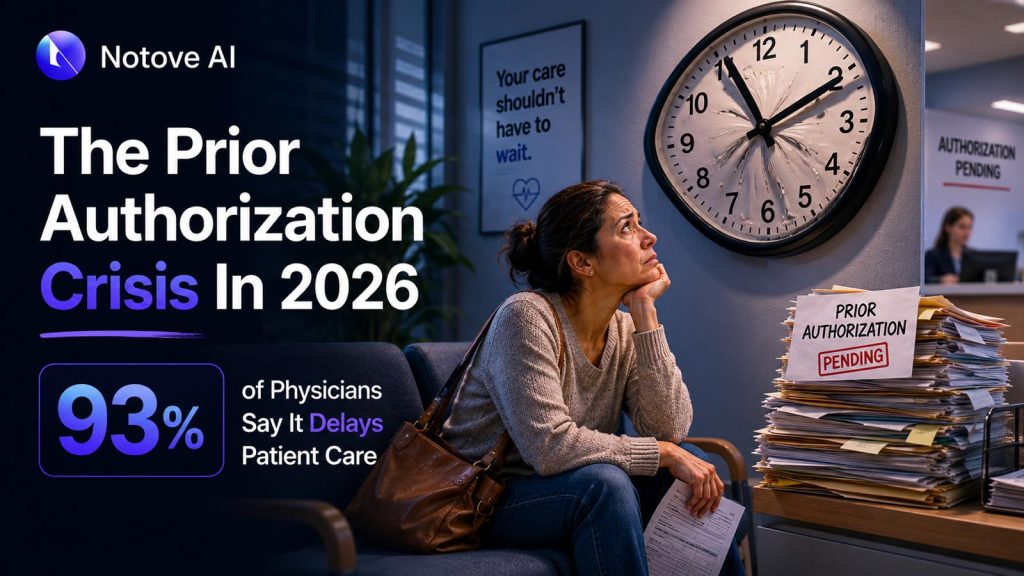
The Prior Authorization Crisis In 2026: 93% of Physicians Say It Delays Patient Care
The Prior Authorization Crisis has quietly become one of the most damaging forces inside American healthcare, and by 2026, it is no longer just a billing complaint. It is a patient safety issue. Picture this: a cardiologist orders a stress test for a patient with chest pain. The patient is anxious, already canceling work to make the appointment. Three days pass. Then five. The insurer wants more documentation. Someone on the care team spends forty minutes on hold. The test slot disappears. A new one is scheduled two weeks out. The patient ends up in the emergency room first.
That sequence, or something close to it, plays out in clinics across the country every single day. According to the American Medical Association, 93% of physicians report that prior authorization delays necessary patient care. That figure is not a talking point. It is a description of how the system actually moves, and what it costs people while it moves.
What Prior Authorization Actually Is
Prior authorization (PA) is a requirement from a health insurer that a provider get approval before a covered service, medication, or procedure will be reimbursed. The stated rationale is reasonable: manage costs, reduce unnecessary care, and ensure treatments meet evidence-based standards. Utilization management in theory is not a bad idea.
In practice, the system has drifted far from that original purpose. Approval criteria are inconsistent across payers and plans. Documentation requirements are opaque and frequently change. Denials arrive without clear clinical justification. Providers submit, get asked for more information, request a peer-to-peer review, wait for a callback that may never come, get denied, appeal, and start over. Each step adds days. Sometimes weeks. And at every stage, the patient is waiting.
What the Statistic Looks Like at the Bedside
When 93% of physicians say prior authorization delays care, the translation into clinic life looks like this: a patient with a lump waits two weeks longer for imaging. A teenager in a mental health crisis waits days for a medication to get approved before it can be prescribed. A post-surgical patient in pain cannot start physical therapy because the authorization window closed while the paperwork was in transit.
The delays hit hardest in cancer workups, cardiology evaluations, chronic pain management, behavioral health, and infusion therapies including biologics. These are not elective situations. Prolonged waits in these categories lead to condition progression, unplanned emergency visits, and in some cases, worse long-term outcomes that are entirely preventable.
There is also a psychological cost that does not appear in claim data. Patients grow frustrated, lose confidence in their care team, and sometimes give up on treatment entirely. Clinicians experience a specific kind of moral injury when they know what a patient needs, the evidence supports it, and the insurer is the only barrier.
Why It Got Worse by 2026
Five distinct pressures have converged to make the Prior Authorization Crisis worse in 2026 than it was even three years ago.
More services and drugs are being routed through PA requirements. Payer lists have expanded, and step therapy protocols, which require patients to try and fail cheaper treatments before accessing what their physician actually prescribed, have become more common across specialties.
Payer rule fragmentation has made the administrative load nearly unmanageable. Each insurer has different portals, different forms, different documentation requirements, and different turnaround timeframes. A practice dealing with fifteen payers is maintaining fifteen different sets of rules.
Staffing shortages and burnout mean there are fewer people to chase approvals. High turnover increases the chance of errors, rework, and dropped follow-ups.
EHR documentation and payer-required fields rarely match. Missing specific clinical language, sometimes called the “magic words” that trigger approval, causes automatic denials even when the clinical case is solid.
Finally, “digital PA” tools that insurers have rolled out often do not save time. They still require manual attachments, ask the same questions in different formats, and ultimately route to a human review queue with no faster resolution.
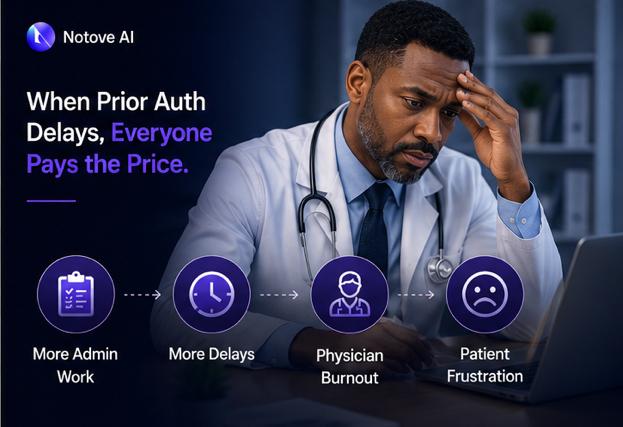
The Real Cost: Time, Money, and Clinical Distortion
The cost of prior authorization goes beyond frustration.
| Cost Category | What It Looks Like in Practice |
|---|---|
| Clinician time | Physicians and staff spend an average of 12+ hours per week on PA tasks across a small practice |
| Delayed revenue | Approved services billed weeks late; denied services rebilled at significant labor cost |
| Appeal labor | Each denial that goes to appeal adds 2 to 4 hours of staff time with uncertain outcomes |
| Treatment abandonment | 1 in 4 patients abandon treatment when PA delays exceed 2 weeks, per AMA data |
| Clinical distortion | Providers increasingly choose what is easiest to approve over what is clinically optimal |
That last row is the most corrosive. When the path of least resistance in clinical decision-making becomes “what will the insurer approve without a fight,” the system is no longer serving patients. It is serving paperwork.
The equity dimension is also significant. Patients with less flexible work schedules, those with limited English proficiency, those without consistent coverage, and those unfamiliar with how to navigate insurance processes are far less likely to successfully advocate for themselves through a denial or delay. They are disproportionately the ones who fall out of care entirely.
Where the Patient Journey Breaks
Starting from a patient’s symptom and tracing the path forward, the failure points are predictable: the provider submits a PA request with incomplete documentation, or the clinical notes use language that does not match payer criteria. The insurer requests more information. The provider is in clinic and cannot respond immediately. The payer closes the window.
A peer-to-peer review gets scheduled. This is a call between the ordering physician and a payer-employed medical reviewer to discuss the case. The problem is that payer-appointed reviewers often call during clinic hours and give narrow windows to respond. Physicians in back-to-back appointments miss the window. The denial stands.
Meanwhile, the imaging slot the patient was supposed to fill gets taken. A new appointment requires a new authorization, and depending on the payer, the prior auth window may have expired. The process starts over.
Patients often blame the clinic for these delays. Understanding that the blockage is a multi-party system problem does not make the wait easier, but it does point toward who actually needs to fix it.
What Patients Can Do Right Now
There are practical steps patients can take without becoming a full-time case manager.
At any appointment where a new test, procedure, or medication is ordered, ask directly: does this require prior authorization, and who is responsible for submitting it? Get the CPT or HCPCS code, the diagnosis code, and the medication name and dose in writing. Ask the clinic for an expected submission date and a rough timeline for payer response.
Use the insurer’s portal or app to check PA status. Document every call with the insurer, recording the date, time, and name of the representative. Reference numbers matter.
If the situation is clinically urgent, ask specifically about expedited or urgent review. Most payers are required to process urgent authorizations within 72 hours. If a denial comes back, ask about the appeals process and whether an employer-based benefits advocate can assist.
Ask the care team about bridge options, whether that is a medication sample, an alternative with a simpler approval path, or interim care that does not require authorization.
What Clinics Can Do to Protect Patient Access
Practices that have reduced prior authorization delays share a common trait: they treat PA as a structured workflow, not a shared responsibility with no real owner.
Standardizing intake is the starting point. A checklist for the top 20 most-authorized services per payer, built into the scheduling and pre-visit process, cuts “missing information” denials significantly. Flagging likely PA items at scheduling rather than at the time of order means documentation can be gathered before the physician signs off.
Templated medical necessity language, aligned to current clinical guidelines and payer-specific terminology, reduces the gap between clinical documentation and what the payer needs to see.
Centralizing PA ownership into a dedicated queue with defined turnaround expectations eliminates the “everyone is responsible so no one follows up” failure mode.
Tracking denial reasons, appeal win rates, and patient drop-off by service type creates the data to have credible conversations with payers and to refine internal workflows continuously.
What Reform Could Actually Look Like
The clearest improvements would be real-time electronic prior authorization, standardized data fields across payers, and publicly accessible medical necessity criteria. “Gold carding,” which allows high-performing providers to skip PA requirements for specific services, has shown promise but needs careful implementation to avoid reinforcing disparities between large health systems and independent practices.
Any reform worth the name needs to pass one test: does it reduce time-to-care for patients, particularly in high-stakes clinical situations? Automation that simply scales the current criteria faster does not help if those criteria are themselves flawed.
Moving Forward When the System Is Not
If the prior authorization process is slowing down your path to care, or creating bottlenecks inside your practice, the answer is not to wait for the system to fix itself. Notove was built specifically to address this problem, automating the documentation gathering, form preparation, and submission tracking that currently consumes hours of clinical and administrative time every week. Visit https://notove.com/ to learn how your practice can reduce prior authorization delays and get patients to care faster.

Frequently Asked Questions
What is the Prior Authorization Crisis and why does it matter in 2026?
The Prior Authorization Crisis refers to the widespread, system-level problem of health insurers requiring advance approval for tests, medications, and procedures in ways that consistently delay necessary patient care. By 2026, expanded payer lists, staffing shortages, fragmented portal systems, and the gap between clinical documentation and payer criteria have made the delays longer and more common than at any previous point.
How long does prior authorization typically take?
Standard prior authorization decisions are supposed to be issued within a few business days, but in practice many requests take one to two weeks or longer when documentation is incomplete or additional information is requested. Urgent or expedited reviews, which apply when a delay could harm the patient, are generally required within 72 hours, though even that timeline is not always met.
Can a patient appeal a prior authorization denial?
Yes. Every insurer is required to provide an appeals process. The first step is usually an internal appeal, submitted in writing within a defined window after the denial. If that is denied, patients and providers can request an external independent review. The peer-to-peer review process, where the ordering physician speaks directly with a payer medical reviewer, can also reverse denials before a formal appeal is needed.
What does “step therapy” mean and how does it relate to prior authorization?
Step therapy is a payer requirement that patients try and document failure with one or more lower-cost treatments before the insurer will cover the treatment the physician actually prescribed. It is tied to prior authorization because the PA request must include evidence of prior treatment steps, and if the documentation is incomplete, the claim is denied. This can delay access to effective treatment by weeks or months.
Why do some prior authorization requests get denied even when the care is medically necessary?
Denials happen for several reasons that have little to do with clinical appropriateness. Missing documentation, clinical language that does not match payer-specific criteria, incorrect procedure or diagnosis codes, expired authorization windows, and plan-level formulary rules all trigger denials. The medical necessity criteria payers use are often proprietary, which means providers cannot easily predict what language will satisfy the reviewer.
How can a clinic reduce the number of prior authorization denials it receives?
The most effective approaches involve treating PA as a structured workflow rather than a reactive task. This means flagging likely PA-required services at the scheduling stage, using templated medical necessity language aligned to payer criteria, centralizing authorization follow-up in a dedicated queue, and tracking denial reasons over time to identify patterns. Practices that have implemented dedicated PA workflows report meaningful reductions in denial rates and resubmission labor.
Share Post:
Be First to Try Notove
Join the waitlist and get early access, updates, and exclusive onboarding support.