

Healthcare AI gets mentioned in almost every clinic meeting now, yet the room rarely agrees on what it means. One person pictures a chatbot answering patient questions. Another pictures software reading an X-ray and flagging a tumor. A third just means anything with the word AI stamped on the box. That confusion matters more in specialty clinics than almost anywhere else in medicine. Radiology, oncology, orthopedic, and cardiology practices carry heavier documentation and authorization demands than a typical primary care office. Before a clinic spends time or budget on it, it helps to know exactly what Healthcare AI covers and where it actually earns its keep.
What Healthcare AI Actually Means
Healthcare AI is the umbrella term for every artificial intelligence tool used anywhere inside a health system. That includes tools a patient interacts with directly and tools that work entirely behind the scenes. It covers scheduling assistants, billing checks, documentation helpers, and diagnostic imaging software alike. The phrase does not point to one product or one function. Healthcare AI is a category, not a single tool. A clinic asking to buy Healthcare AI is a little like asking to buy software in general. The real question is which slice of that category actually fits a specific problem.
Healthcare AI Is Not One Single Tool
Vendors often blur these categories together in a sales pitch. Understanding the real types of Healthcare AI makes it easier to see past the noise. The table below breaks down the main categories and where specialty clinics typically encounter each one.
| Type of Healthcare AI | What It Actually Does | Common Use in Specialty Clinics |
|---|---|---|
| Machine learning | Learns patterns from past data to predict outcomes | Flagging claims that are likely to be denied |
| Natural language processing | Reads and organizes text from notes and records | Pulling clinical details for authorization requests |
| Generative AI | Drafts new text based on existing information | Writing referral letters or visit summaries |
| Predictive AI | Forecasts future events from historical trends | Estimating no-show risk or staffing needs |
| Agentic AI | Carries out multi-step tasks with limited human input | Gathering documents and submitting authorization requests |
| Computer vision | Analyzes images to detect visual patterns | Reviewing imaging studies in radiology |
Most clinics interact with two or three of these types at once, often without realizing it. A single prior authorization workflow might use natural language processing to read a chart, then hand the assembled request to an agentic AI system for submission.
Clinical Healthcare AI vs Administrative Healthcare AI
Healthcare AI splits into two broad lanes, and the difference shapes how fast a clinic can actually adopt it. Clinical Healthcare AI touches diagnosis and treatment decisions directly. Software that reads a mammogram or suggests a drug dosage sits in this lane. It usually needs FDA clearance, the federal review process confirming a medical tool is safe and effective, before any clinic can use it. That process can take years. Administrative Healthcare AI works outside the clinical decision itself. It handles scheduling, documentation, billing, and prior authorization instead. Because it never touches a diagnosis, it moves through adoption far faster. That speed gap is a big reason administrative Healthcare AI is already running inside specialty clinics well ahead of most clinical tools.
Where Healthcare AI Shows Up First in Specialty Clinics
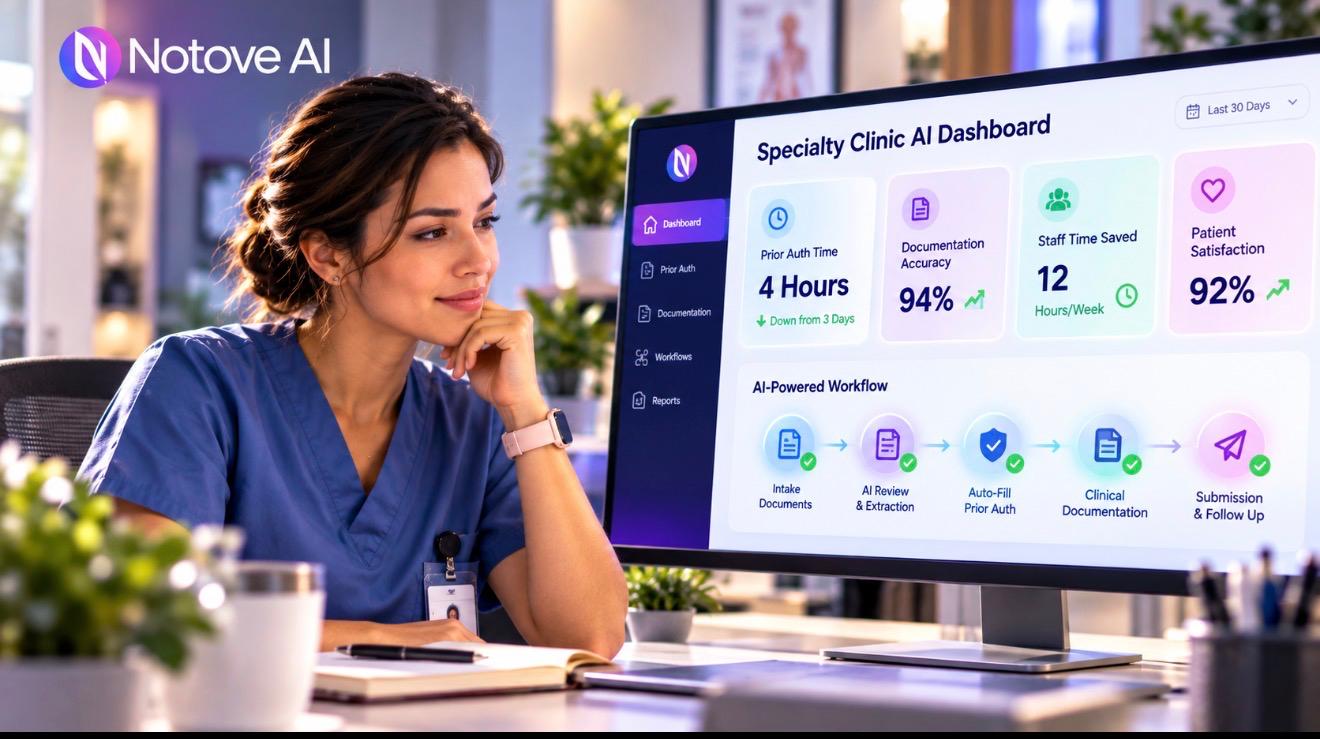
Administrative Healthcare AI tends to land first in the parts of a clinic already under the most strain. Prior authorization sits near the top of that list. The average physician handles dozens of authorization requests every week, and each one eats staff hours before a payer even responds. Healthcare AI can gather documentation and prepare that request automatically, shortening the wait between an order and an approval. Denials sit close behind prior authorization on that same list. A clinic reworking the same denials management problems every month often finds Healthcare AI useful for catching errors before a claim goes out at all. Weak patient access is another common entry point, since scheduling and intake generate huge amounts of repetitive work. Documentation is a third. Strong clinical documentation improvement habits make every downstream Healthcare AI tool more accurate, since these systems are only as reliable as the notes they read.
How Healthcare AI Differs Across Specialties
Healthcare AI rarely behaves the same way twice across different specialties. Radiology clinics tend to see it first in image review, where computer vision tools flag patterns for a radiologist to confirm. Oncology practices often meet Healthcare AI through authorization work, since treatment timelines leave little room for a stalled approval. Orthopedic groups lean on it for imaging-heavy referrals, where missing documentation is a common cause of delay. Cardiology practices frequently use it to manage recurring procedure authorizations, since many patients return for repeat testing. The shared thread across every specialty is documentation. Healthcare AI performs best where clinical detail is dense and repetitive, which is exactly the environment specialty clinics operate in every day.
What Healthcare AI Cannot Replace
Every Healthcare AI tool worth using still depends on a human reviewing its output before anything gets submitted or acted on. Administrative Healthcare AI can gather documents and draft a request, but staff still confirm that request is accurate and complete. Clinical Healthcare AI can flag a pattern on an image, but a physician still makes the diagnosis. That review layer is not a limitation to work around. It is the reason Healthcare AI can be trusted with sensitive clinical and financial information in the first place. Clinics that treat Healthcare AI as a full replacement for judgment tend to run into accuracy problems quickly. Clinics that treat it as a way to remove repetitive work tend to see the strongest results.
How to Evaluate a Healthcare AI Tool Before Adopting It

Not every Healthcare AI product on the market deserves a place in a specialty clinic. A few questions separate a genuinely useful tool from an overhyped one. Does it work inside the clinic’s existing EHR, the electronic health record system holding patient charts, or does it demand a separate login? Does a human still review its output before anything reaches a payer or a patient? Is the vendor specific about which task the tool automates, or vague about doing everything at once? Does it name real compliance standards like HIPAA, the federal law governing patient data privacy, instead of gesturing at security in general terms? A clinic that runs a new Healthcare AI tool through these questions avoids most of the expensive mistakes other practices have already made.
Bringing Healthcare AI Into Your Clinic
Healthcare AI is not one product waiting to be purchased off a shelf. It is a growing set of tools, and the administrative side of that set is already changing daily work inside specialty clinics. Prior authorization remains one of the clearest, lowest-risk places for a practice to start. This breakdown of the healthcare revenue cycle shows exactly where authorization and other administrative steps fit into the larger financial picture a clinic manages every day. Notove AI was built around that exact problem, helping specialty clinics automate the documentation and submission work behind prior authorization. If your team is buried in payer paperwork, it may be worth seeing how this fits your workflow. You can join the waitlist to get early access and see it in action.
Frequently Asked Questions
What is Healthcare AI in simple terms?
Healthcare AI means any artificial intelligence tool used inside a health system. That includes tools patients interact with directly and tools working entirely behind the scenes. It spans scheduling, billing, documentation, and diagnostic support alike.
Is Healthcare AI the same as clinical AI?
No. Clinical AI is a smaller category inside Healthcare AI focused only on diagnosis and treatment decisions. Healthcare AI also includes administrative tools like scheduling and prior authorization, which never touch a clinical decision directly.
Do specialty clinics need different Healthcare AI tools than primary care?
Generally, yes. Specialty clinics carry heavier documentation, imaging, and authorization requirements than primary care. Generic Healthcare AI products built for high-volume general practice often miss the payer rules unique to specialties like oncology or radiology.
Does Healthcare AI replace clinical or administrative staff?
Not typically. Most Healthcare AI tools handle repetitive preparation work while a human still reviews and approves the final output. That combination of automation and oversight is standard across reputable healthcare AI products today.
How fast can a specialty clinic adopt Healthcare AI?
Administrative Healthcare AI can often be adopted within weeks, since it avoids the FDA clearance process required for clinical tools. Clinical Healthcare AI usually takes years because of the validation and regulatory review involved.
Is Healthcare AI safe for patient data?
Reputable Healthcare AI vendors follow HIPAA requirements and use encryption to protect patient information. Clinics should still confirm compliance details directly with any vendor before sharing clinical or billing data.