
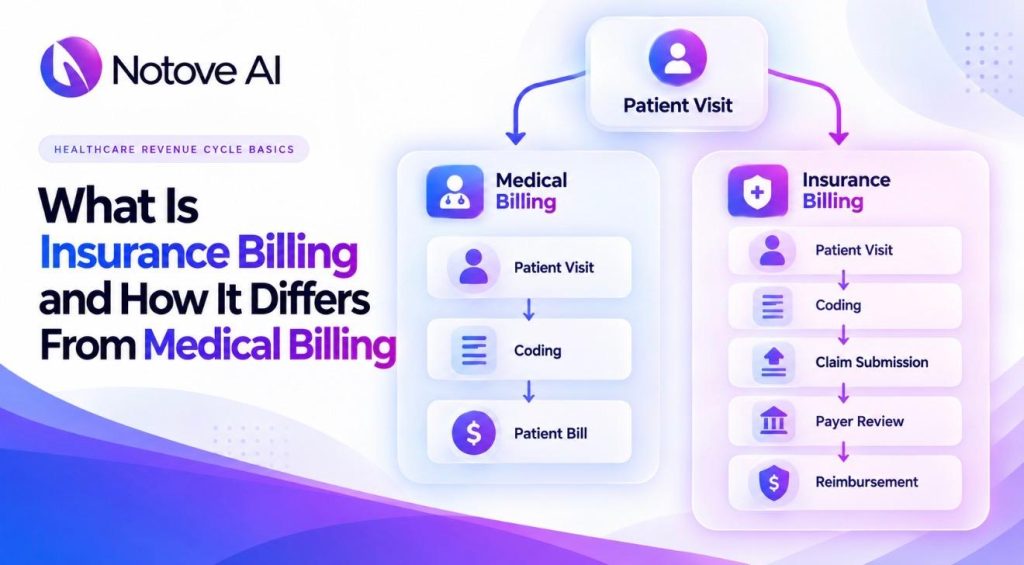
Insurance billing is the part of a clinic’s revenue cycle where claims go to payers for payment. Medical billing is the bigger process that surrounds it. Many clinics use the two terms as if they mean the same thing. They don’t, and the gap causes real confusion at the front desk.
A patient asks why they got a bill after insurance paid. A new hire asks who owns a rejected claim. Both questions trace back to the same mix-up. This guide explains insurance billing in plain terms. It also shows how it differs from medical billing, one step at a time.
What Is Insurance Billing?
Insurance billing is the work of sending claims to a patient’s insurer and following them until they’re paid. The clinic submits a claim after the visit. The payer then checks coverage, medical necessity, and contract rules. After that, it approves, adjusts, or denies the claim.
Insurance billing ends when the payment is posted and any leftover balance is routed to the right place. Professional claims go on the CMS-1500 form or its electronic version, the 837P. Facility claims use the UB-04 form instead. Most outpatient specialty clinics send professional claims.
Two Meanings of Insurance Billing
The phrase has a second meaning outside healthcare. Insurance companies also bill their own customers for premiums. That is insurance billing from the insurer’s side. This article uses the provider meaning, since that is how clinics use it.
What Is Medical Billing?
Medical billing covers the full path from patient check-in to final payment. It includes insurance billing, but it doesn’t stop there. It also covers registration, eligibility checks, and patient statements. Payment posting, collections, and reporting belong to it as well.
Many teams split the work into two halves. Front-end tasks happen before and during the visit. Back-end tasks begin once the claim leaves the building. A smooth cycle needs both halves working together.
Medical coding feeds the process. Coders turn the visit note into standard codes. Billers then use those codes to build the claim. Our guide to medical claims and how the claims process actually works covers that step in detail.
Insurance Billing vs Medical Billing: The Real Difference

Think of medical billing as the whole journey. Insurance billing is one leg of that trip. It’s also the leg that most affects cash flow.
A simple example shows how the money splits. Say a specialist charges $200 for a visit. The deductible is met, and coinsurance is 20 percent.
| Money step | Amount | Which process owns it |
|---|---|---|
| Clinic charge for the visit | $200 | Medical billing |
| Payer’s allowed amount | $150 | Insurance billing |
| Contractual write-off | $50 | Insurance billing |
| Insurer pays 80 percent of the allowed amount | $120 | Insurance billing |
| Patient pays 20 percent coinsurance | $30 | Medical billing |
Insurance billing handles the $120 payment and the $50 adjustment. Medical billing handles the $30 patient balance and everything around it. Both bills come from one visit, but they follow different rules.
Who You Deal With
Insurance billing means working with payers, portals, and clearinghouses. Medical billing adds patients, who need clear statements and payment options. The tone changes too. Payer calls are about codes and policy. Patient calls are about worry and cost.
Insurance Billing Terms That Get Mixed Up
A lot of the confusion comes from vocabulary. This table sorts the terms and shows who receives each document.
| Term | What it means | Who receives it |
|---|---|---|
| Claim | A request for payment sent after a visit | The payer |
| Explanation of benefits (EOB) | The payer’s summary of how it processed a claim | The patient |
| Remittance advice (ERA) | Payment details and adjustment codes | The clinic |
| Statement | A bill for the patient’s remaining balance | The patient |
| Clean claim | A claim with no errors that would block payment | The payer |
| Allowed amount | The most the payer will recognize for a service | The clinic and patient |
The EOB causes the most trouble. It looks like a bill, but it isn’t one. The ERA is for the clinic, not the patient. Teach front-desk staff to explain that difference.
The Insurance Billing Process Step by Step

Most clean claims follow the same path. Here is how insurance billing usually runs in a clinic.
- Verify eligibility and benefits. Confirm active coverage, copays, and deductibles before the visit.
- Check prior authorization. Some imaging, surgical, and specialty services need payer approval first.
- Capture charges and codes. The provider documents the visit, and a coder assigns codes.
- Scrub and submit the claim. Software or staff catch errors before the payer does.
- Track the claim. Watch for payer questions, rejections, and long delays.
- Post payment and work denials. Match the remittance to the claim, then appeal or correct what’s wrong.
Each step protects the next one. Skipping one rarely saves time. A skipped eligibility check shows up as a denial weeks later. The first two steps happen before the patient sees the doctor. That’s why front-desk staff shape insurance billing more than most people realize.
Who Handles Insurance Billing in a Clinic
In a small clinic, one person may do all of this. In a larger group, the work splits across roles. Front-desk staff handle registration and eligibility. Coders assign the codes. Billers build and track claims. Authorization specialists manage payer approvals. A practice manager watches the numbers.
The split matters because each handoff can lose information. Clear definitions of insurance billing and medical billing keep those handoffs clean.
Job titles add to the confusion. One clinic may post for an insurance biller. Another may call the same role a medical biller. The tasks overlap, but the scope can differ. Read the job description, not just the title.
Why Insurance Billing Errors Start at the Front Desk
Many denied claims trace back to the front end. Common denial reasons include missing authorization, ineligible patients, coding errors, duplicates, and late filing. Many of them are preventable with better front-end checks.
A clear denials management strategy turns those patterns into fixes. Track denial reasons by payer and by procedure. Then fix the habit that caused each one.
The Patient Side of the Bill
Patients rarely separate the two kinds of billing. They see one confusing paper trail. The EOB arrives first, and the statement follows later.
Confusing bills also hurt patient experience in healthcare, which clinics now track as a business metric. Tell patients early what insurance covers and what they may owe. A quick estimate at check-in prevents many angry calls.
How AI Is Changing Insurance Billing
Prior authorization is where insurance billing often breaks first. Staff gather records, fill payer forms, and wait on hold. One missing detail can sink the claim later.
Healthcare AI can take on much of that repetitive work. Notove AI detects procedures that need authorization. It pulls clinical evidence from the EHR and prepares payer-specific requests. Staff then review and submit in seconds. Cleaner requests mean fewer denials downstream. They also free your team for work that needs a human. Think of patient calls, payer disputes, and complex appeals. Those tasks deserve more attention than data entry gets.
Final Thoughts on Insurance Billing
Insurance billing and medical billing overlap, but they aren’t twins. Insurance billing gets the clinic paid by the payer. Medical billing keeps the whole money cycle running, patient balance included.
Once your team shares those definitions, handoffs get cleaner and denials get easier to trace. Prior authorization is a good place to start tightening things up. See how Notove AI prepares payer-ready authorization requests for your clinic. Ready to try it? Join the waitlist for early access.
Insurance Billing FAQs
Is insurance billing the same as medical billing?
No. Insurance billing is the part of medical billing that targets payers. Medical billing also covers registration, coding handoffs, patient statements, and collections. Many people use the terms interchangeably, but the scope differs.
What does an insurance billing specialist do?
An insurance billing specialist prepares and submits claims to payers. They also track claim status, post payments, and follow up on denials. Some also verify eligibility and request prior authorizations.
Which forms are used for insurance billing?
Professional services use the CMS-1500 form or the 837P electronic claim. Facility services use the UB-04 or the 837I. The right form depends on whether a professional or a facility is billing.
How long do you have to file an insurance claim?
Each payer sets its own timely filing limit. Windows often range from 90 days to one year from the date of service. Check your payer contract for the exact deadline. Late claims are usually denied, and appeals rarely reverse that.
Can AI help with insurance billing?
Yes, especially with repetitive front-end work. AI can detect when a procedure needs prior authorization. It can also gather documentation and prepare payer-specific forms. Staff should still review each request before submission.