
Clinical Documentation 101: Why It Makes or Breaks Your Insurance Approvals
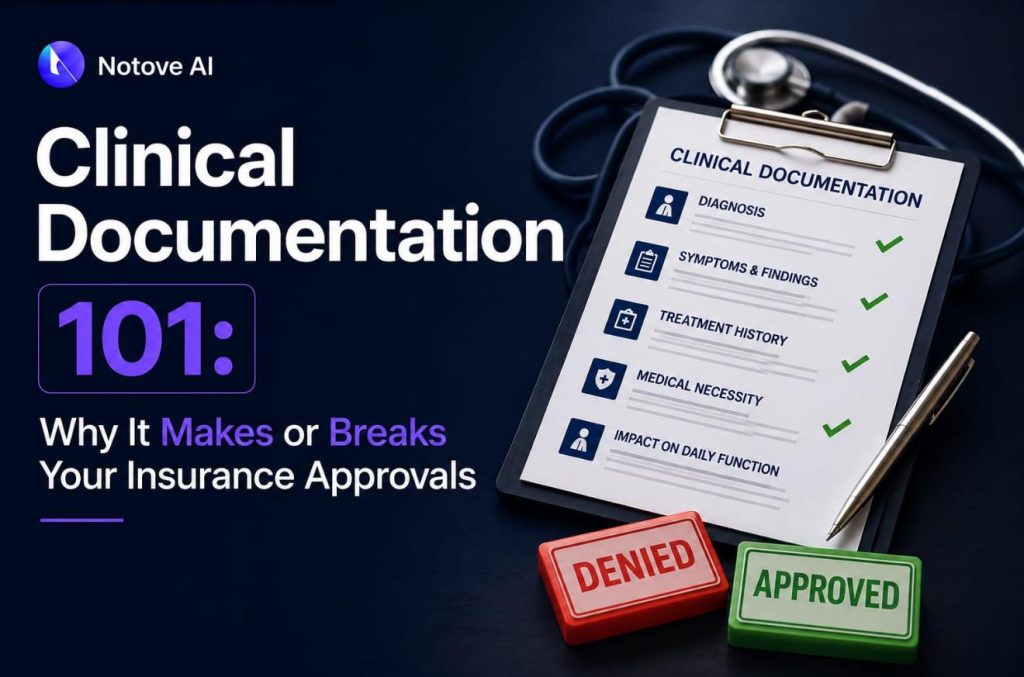
Clinical Documentation 101: Why It Makes or Breaks Your Insurance Approvals Clinical documentation is the difference between a claim that sails through and one that stalls for weeks while your patient sits in limbo. If you have worked in behavioral health or any specialty that deals with payer review, you already know this feeling: the care plan is solid, the clinical reasoning is there, the patient clearly needs this level of care, and yet the prior authorization or continued stay request comes back denied. Not because the care was wrong. Because the note did not prove it in the way a reviewer could act on it. This article covers documentation that supports insurance approvals: prior authorizations, continued stay reviews, claims, and audits. It is written for clinicians, care teams, and anyone involved in treatment planning, utilization review, or payer-facing documentation in behavioral health and healthcare operations. Nothing here is legal advice, and you should always follow your payer, state, and facility policies. What this is, is practical guidance on how to close the gap between clinical quality and payer sufficiency. What Insurers Actually Look for (And Why “Good Notes” Still Get Denied) Payers do not read your notes the way a clinical supervisor does. They are looking for coverage criteria, and they are looking fast. A compassionate narrative about a patient’s struggles is not the same thing as a defensible medical necessity argument, even if it tells a better story. Coverage decisions are evidence-based and criteria-driven. Reviewers are checking for a specific set of signals: diagnosis, severity, risk, functional impairment, skilled need, and treatment response. When any of those pieces are absent or vague, the decision defaults to denial. The most common disconnects that trigger denials are not clinical failures. They are documentation failures. A diagnosis that does not match the symptoms described in the assessment. Goals so broad they cannot be measured. No documented objective change between review periods. Risk documented on admission and then never mentioned again. A discharge plan that does not exist. These are the gaps that reviewers find, and they find them every time. Clinical Documentation 101: The Non-Negotiables Clinical documentation in this context is a legal record, a clinical record, and a reimbursement record all at once. Most payers expect to see the following components consistently across the chart: presenting problem, diagnosis support, risk, functional impact, treatment plan, skilled interventions, treatment response, ongoing need, and discharge or step-down planning. That last word, consistently, matters more than most teams realize. A thorough intake assessment means nothing if the daily progress notes describe a different patient. The assessment, the plan, the notes, the utilization review summaries, and the discharge summary all need to tell the same story with the same facts. Medical Necessity: How to Document It So a Reviewer Cannot Miss It Medical necessity answers three questions in plain language: why this level of care, why now, and why for this patient specifically. Reviewers are asking the same three questions in a slightly different form: Is the problem covered? Is the level of care appropriate? Is there evidence it is working and still needed? To answer those questions clearly, your documentation needs to include severity, acuity, risk, functional impairment, history of failed lower levels of care, why the current intensity or structure is required, and a clinical rationale tied to individualized goals. Not boilerplate. Not a template dropped in unchanged from the last patient. The clinical rationale needs to reflect this person’s presentation. Objective Evidence: Turning Symptoms Into Reviewable Proof Payers prefer observable, quantifiable detail over subjective clinical impressions. That does not mean your clinical judgment does not matter. It means your clinical judgment needs to be shown, not just stated. Objective documentation looks like this: frequency, duration, and intensity of symptoms; sleep and appetite changes; attendance and participation; functioning in daily activities, work, or school; withdrawal scales or vitals where applicable; and standardized measures when they are being used. Documenting a trend over time, from baseline to current status and the delta in between, tied directly to your interventions, is what builds a reviewable case for ongoing care. The phrase “doing well” without any metrics is one of the fastest ways to trigger a denial. Show what changed, and show what is still impaired. Risk and Safety: Document Like It Matters Risk documentation directly supports level-of-care decisions and continued stay justifications. What to include: suicidal and homicidal ideation, self-harm behaviors, psychosis or mania, intoxication or withdrawal risk, domestic violence or environmental safety concerns, and inability to adequately care for oneself. Beyond listing risks, document protective factors, assign a risk level with your rationale, and connect that risk level to the safety plan elements you have in place. One common pitfall that reviewers notice immediately: risk is documented thoroughly on day one and then disappears from the notes for a week. Continuity of risk documentation is not optional. It is what keeps a continued stay review from falling apart. Goals, Interventions, Response: The Care Loop That Drives Continued Stay The logic reviewers follow is a loop: problem leads to goal, goal leads to intervention, intervention leads to patient response, response leads to the next plan. If any link in that chain is broken or missing, the case for continued stay weakens. Goals need to be specific and measurable. “Reduce anxiety” is not a goal a reviewer can evaluate. “Patient will identify and use two coping strategies when anxiety exceeds a self-rated 7/10, three times per week” gives a reviewer something to look for. Document what the clinician actually did as a skilled intervention, not just that a session occurred. And capture the response: what is working, what is not, and what changed in the plan as a result. Where Approvals Fail Most Often: 8 Documentation Mistakes That Trigger Denials Mistake Why It Causes a Denial Vague language (“stable,” “improving”) with no evidence Reviewers cannot confirm necessity without measurable support Copy/paste notes that do not reflect today’s presentation Signals that the note does not represent
The Hidden Cost of Manual Prior Authorization in Radiology Practices

The Hidden Cost of Manual Prior Authorization in Radiology Practices Manual Prior Authorization is costing your radiology practice far more than you realize, and most of it never shows up as a single line item anywhere in your financials. It hides in payroll, in scanner downtime, in the patient who got tired of waiting and booked somewhere else, and in the authorization specialist who quietly started looking for a new job three months ago. This article breaks down where those costs actually live, how to find them in your own operation, and what you can do about it before they compound further. What “Manual Prior Authorization” Actually Looks Like in Radiology Before talking about costs, it helps to be specific about what manual prior authorization means in practice. It is not a single task. It is a chain of human-driven steps: verifying benefits and eligibility, gathering clinical documentation from the referring provider, looking up payer-specific criteria, submitting through a portal or by fax or by phone (sometimes all three for the same case), scheduling a peer-to-peer if the payer pushes back, checking status repeatedly, documenting the outcome, and finally releasing the appointment to scheduling. For advanced imaging, the chain gets longer. CT, MRI, and PET scans often go through radiology benefit managers like eviCore or NIA rather than directly to the payer. Each RBM has its own portal, its own clinical criteria, and its own timeline. A case that starts with a fax might end with a peer-to-peer call three days later. And if the clinical note from the ordering physician was incomplete when it arrived, the whole process stalls and restarts. The word “manual” matters because it means a person is doing each of those steps, across every case, every day, while the phone is also ringing and the portal is also timing out. The Hidden Costs: Where It Hits Your Practice 1. Direct Labor: The Authorization Shadow Workforce The most immediate cost is the staff time being consumed. Schedulers, PA specialists, clinical reviewers, billing staff, and occasionally radiologists for peer-to-peer calls are all part of the authorization ecosystem. Most practices have never added up what that actually costs. A simple framework: multiply your average minutes per case by your blended hourly rate across roles involved, then by your monthly authorization volume. Even at a conservative estimate of 20 minutes per case for routine submissions and a blended rate of $25 per hour, a practice processing 400 authorizations a month is spending around $3,300 in direct labor just on the submission step. Add status checks, rework, and peer-to-peer prep, and that number climbs fast. What compounds this is the interruption cost. Every time a staff member stops to log into a different portal, chase a missing clinical note, or wait on hold with an insurance company, they lose their working rhythm on everything else. 2. Revenue Delay: Slower Approvals, Slower Cash Authorization delay creates a chain reaction that goes straight to your cash flow. No approval means no scheduled scan. No scheduled scan means no charge capture. No charge capture means slower payment, and in the meantime the auth validity window is ticking down. Payer authorizations typically expire within 90 days, sometimes less. If a case gets approved but scheduling is delayed because of backlog or patient availability, that auth can expire before the scan ever happens. Now the team has to resubmit, restart the clock, and the scanner slot sits open in the meantime. High-deductible plan patients add another wrinkle. When timing is uncertain, the conversation about patient financial responsibility gets harder to have, and practices often defer it rather than deal with it mid-auth chaos. That deferred conversation becomes a collections problem later. 3. Denials and Rework: Doing the Work Twice Denial rates tied to authorization issues are not small. Common drivers include medical necessity criteria mismatch, incomplete clinical documentation, CPT and ICD-10 pairing errors, expired authorizations, and site-of-service problems. Each of those is a failure point that a manual workflow is more likely to produce than an assisted one. When a denial comes in, someone has to investigate the reason, gather additional documentation, coordinate a peer-to-peer if applicable, resubmit, and then follow up again. That is often 45 to 90 minutes of additional work on top of what was already spent. For a practice with a meaningful denial rate, this rework is effectively paying twice for the same case. 4. Capacity Loss: Empty Scanner Slots Nobody Can Fill Last-Minute Pending authorizations block schedule slots. When an approval comes through unexpectedly, there is rarely a patient ready to fill that slot on short notice. When an authorization falls through at the last minute, the patient gets rescheduled and the time is lost. The downstream effects reach the whole operation: longer wait times for routine cases, overtime for technologists when urgent add-ons get pushed in, and referring physician frustration when their patients can not get timely appointments. Radiology runs on throughput. Anything that creates irregular scheduling gaps undermines the efficiency the whole revenue model depends on. 5. Patient Leakage: Authorization Friction Sends Patients Elsewhere Patients are not loyal to imaging centers that are hard to schedule. If the authorization process creates repeated calls, unclear status updates, or last-minute cancellations, a meaningful share of patients will follow their referring physician’s next suggestion to a different facility. They often do not complain. They just do not come back. Referring offices feel this too. Their staff will gravitate toward imaging centers that give them clean, predictable authorization experiences. If your practice is the one that always needs to call back for more information or keeps cases in limbo for days, you will start losing referrals to competitors who have tightened up their intake process. 6. Compliance and Audit Exposure Manual authorization processes produce inconsistent documentation. An approval obtained by phone gets logged differently than one obtained through a portal. A fax confirmation gets filed somewhere that is not the same place as the portal screenshot. When an audit comes, or
How Medical Prior Authorization Delays Are Directly Harming Patient Outcomes
How Medical Prior Authorization Delays Are Directly Harming Patient Outcomes Medical Prior Authorization, the process insurers use to approve treatments before they are covered, has become one of the most debated friction points in American healthcare. And the debate is not really about whether the process should exist. It is about what happens in the time between a clinician ordering care and an insurer signing off on it. That gap is not neutral. It has a clinical cost, and in many cases, that cost is paid by the patient. This article looks at where delays actually occur, what they do to patient outcomes, and what can realistically be done about it across patients, practices, and payers. What Prior Authorization Actually Is (And How It Works in Practice) Prior authorization (PA) is a requirement that a clinician or facility obtain insurer approval before certain medications, procedures, imaging studies, or specialist visits will be covered. The intended logic is that it filters out low-value or unnecessary care and controls spending. The workflow typically looks like this: a clinician places an order, the system flags that PA is required, staff submit documentation to the insurer, the insurer reviews it and either approves, denies, or requests additional information. If additional information is requested, the clock effectively resets. If denied, an appeal can be filed. That appeal may go through reconsideration, an internal review, or an external independent review, in that order. PA is distinct from related terms that often get conflated. Precertification refers specifically to pre-approval for planned procedures. Step therapy requires patients to try and fail on a less expensive medication before the preferred one is approved. Formulary restrictions simply limit which drugs are covered at all. The stated rationale from payers is cost control and clinical safety. The practical tradeoff is access delay, and when care is time-sensitive, that tradeoff is not abstract. The 7 Bottlenecks That Actually Slow Things Down Understanding where delays accumulate is the first step to addressing them. There are seven recognizable choke points in the typical PA process. The first is unclear or shifting payer criteria. Documentation requirements are not always published, and they vary by plan, by drug, and sometimes by the reviewer. A submission that would have been approved last month may be denied today because the insurer quietly updated its policy. The second is administrative back-and-forth. Missing a single diagnosis code, submitting the wrong form version, or attaching the wrong clinical note is enough to trigger a rejection that requires starting over. The third is payer response time windows. Standard PA timelines can extend to 72 hours or longer. When a payer sends a request for more information, the internal clock often resets entirely. A one-week process can stretch into two. The fourth is peer-to-peer scheduling. When a clinician needs to speak directly with a payer’s medical reviewer, that call does not happen the same day. Coordinating schedules across organizations often adds several days, if not more. The fifth is the multi-layer appeals process. Even when a denial is wrong, reversing it requires going through reconsideration, then internal appeal, then potentially external review. Each step takes time that the patient does not always have. The sixth is specialty pharmacy logistics. Even after a medication is approved, it still needs to go through benefit investigation, prior authorization at the pharmacy level, and shipping. A three-day clinical delay can become a 10-day total delay by the time the medication arrives. The seventh is re-authorization for ongoing therapies. Patients on stable chronic medications or biologics frequently have to re-qualify mid-treatment. If re-authorization is delayed, therapy is interrupted even though the clinical case has not changed. How Delays Translate Into Worse Outcomes There are six reasonably direct pathways from a PA delay to clinical harm. The first is disease progression. When a patient is waiting for approval, their condition does not pause. Inflammatory conditions flare. Tumors progress. Infections advance. Every day without treatment is a day the disease is running without resistance. The second is missed diagnostic windows. A delayed MRI or lab panel can push a diagnosis into a later and less treatable stage. The decision to image was made at the right time. The image just never happened when it should have. The third is therapy interruption. Stopping and restarting a medication is not the same as never starting it. For some treatments, consistency is the mechanism of action. Interruptions reduce efficacy and, in some cases like certain psychiatric or antiretroviral medications, increase resistance risk. The fourth is substitution with inferior options. Step therapy forces patients onto less effective treatments first. A patient who needs a biologic ends up on an NSAID. A patient who cannot tolerate a first-line medication must fail it formally before a better option is approved. The fifth is avoidable emergency department visits and hospitalizations. When outpatient care is blocked, conditions escalate. A patient who could not get a covered infusion appointment ends up in the ED. That visit is more expensive, more traumatic, and more resource-intensive than the outpatient care that was delayed. The sixth is treatment abandonment. Many patients simply stop pursuing care when the approval process becomes overwhelming. The complexity, the phone calls, the re-submissions, and the uncertainty are enough to cause some patients to give up entirely. What the Evidence Shows The professional and research consensus on this is consistent. The American Medical Association has surveyed physicians annually on PA and found, year after year, that the majority report that PA has caused delays in care, and a significant portion report it has led to serious adverse events for their patients. Studies tracking overturned denials are particularly telling. When PA denials are appealed and reversed, it means the original denial was incorrect. But the reversal does not undo the delay. A patient whose approval was held for three weeks while an appeal worked its way through review still waited three weeks. The clinical damage from that window is not recovered just because the final answer was yes.
The Real Cost of Administrative Burden on Small and Independent Clinics In 2026

The Real Cost of Administrative Burden on Small and Independent Clinics In 2026 Independent clinics are quietly bleeding out, not from malpractice or bad clinical outcomes, but from the sheer weight of running a practice in 2026. If you own or manage a small practice, you already know the feeling: you finish seeing patients, and then the real work begins. Prior authorizations, denial appeals, credentialing renewals, payer portal logins, HR questions, and billing calls from confused patients. It does not stop, and most owners have no idea how much it is actually costing them. This article breaks down the real costs of administrative burden on independent clinics, gives you a model to quantify your own exposure, and points to practical fixes that do not require an enterprise IT budget or a team of 20. What Counts as Administrative Burden (And What Does Not) Administrative burden is not just “paperwork.” For the purposes of this article, it is every non-clinical task your practice must complete to get paid, stay compliant, and keep operations running. That includes billing and claims work, denials management, prior authorization, eligibility and benefits checks, coding documentation demands, payer portal navigation, contracting, credentialing, compliance tasks, HR, scheduling friction, and patient billing calls. What it does not include is clinical documentation that genuinely improves care quality, or true patient-facing clinical coordination, though admin-heavy workflows have a habit of bleeding into both. A useful way to sort the pile: some burden is payer-driven (authorizations, portals, claim rules), some is regulation-driven (HIPAA, reporting requirements, licensing), and some is internal process-driven (manual handoffs, duplicated data entry, undefined roles). Each category needs a different solution. The Real Cost: A 5-Bucket Model to Quantify Admin Burden Most clinic owners look at payroll and software costs, add them up, and stop there. That calculation misses most of the damage. Here is a more complete model. Bucket 1 is direct labor costs. Bucket 2 is lost clinician time. Bucket 3 is revenue leakage. Bucket 4 is technology and vendor overhead. Bucket 5 is hidden human costs like burnout and turnover. Run through each one, and you will likely find your administrative burden is worth two to four times what you assumed. Bucket 1: Direct Labor Costs (The Obvious Part) In independent clinics, the front desk, biller, medical assistant, office manager, and often the owner personally carry the administrative load. Common labor-heavy workflows include eligibility checks before every visit, claim status follow-up calls, payment posting corrections, scanning and faxing referrals, and spending time inside payer portals that are each designed differently. To estimate this cost: take the hourly loaded wage for each role (salary plus benefits and employer taxes), multiply by the hours per week spent on admin tasks, and add overtime and any temp staffing you rely on during crunch periods. One pattern that makes it worse is what operations consultants call “role drift,” meaning clinical staff end up doing non-clinical admin work because the system around them is broken. When your medical assistant spends 40 minutes a day tracking down prior auth status updates, that is clinical capacity being converted into administrative overhead. Bucket 2: Lost Clinician Time (The Expensive Part) Thirty minutes per day of physician admin time feels manageable. It is not. A physician generating $250 per clinical hour who spends 30 minutes a day on non-clinical tasks loses roughly $3,000 per month in potential collections. Multiply that across a year and across two or three providers, and the number gets uncomfortable fast. Beyond the math, there is a downstream effect that compounds the problem. When physicians are squeezed on time, visits get shorter, documentation gets rushed, and coding errors increase. More coding errors lead to more denials. More denials lead to more admin work. The loop closes on itself. Bucket 3: Revenue Leakage (The Silent Killer) Revenue leakage is the money you earned but never collected. It shows up as undercoding, missed charges, timely filing misses, denied claims that no one got around to appealing, write-offs from inaccurate eligibility checks, and bad debt from patient balances that were never clearly communicated upfront. Leakage gets worse when admin is overloaded. When one person owns too many steps with too little time, follow-up cadences slip, and partial payments go uncontested. To estimate your leakage exposure, look at your denial rate multiplied by your average allowed amount, then estimate the percentage of those denials that are never recovered. Add in your A/R aging beyond your target days. For many independent clinics, that number alone justifies a full workflow review. Bucket 4: Technology and Vendor Overhead (Death by a Thousand Tools) A typical small clinic in 2026 is running some combination of an EHR, a practice management system, a clearinghouse, an eligibility tool, a prior auth tool, an eFax service, a phone system, a patient texting platform, a payment processor, a reputation management tool, compliance training software, and a security solution. That is before you count the three or four payer portals with separate logins. The cost is not just the subscription fees. It is the implementation time, the staff training, the credentialed access setup, the password resets, the duplicate data entry between systems that do not talk to each other, and the hours your office manager spends managing vendors instead of managing operations. The term for what happens when tools do not integrate is “workflow tax.” Staff become the integration layer, manually moving data from one screen to another, which is both slow and error-prone. Here is a simplified look at where tech overhead tends to cluster in independent clinics: Tool Category Avg Monthly Cost Internal Hours to Manage Integration Risk EHR / PM System $300-$1,200 8-15 hrs High if siloed Clearinghouse $100-$400 3-6 hrs Medium Prior Auth Platform $200-$600 5-10 hrs High Patient Communication $100-$300 2-4 hrs Medium Compliance / Security $150-$500 4-8 hrs Low to Medium The dollar costs are often manageable. The internal hour costs are where small clinics get hurt. Bucket 5: Hidden Costs (Burnout, Turnover, Patient Experience) The path
AI Agents vs Traditional Prior Authorization Teams: Why Clinics Are Automating Prior Authorization

Why Physicians Spend 13 Hours a Week on Prior Authorizations and What It’s Costing You Prior authorization has a way of finding you before your day even starts: it’s 7:15 AM, your first patient hasn’t walked through the door yet, and you’re already staring at a backlog of PA requests, payer portal notifications, and voicemails from pharmacy staff. By lunch, you’ve spent 45 minutes justifying a medication your patient has been stable on for two years. By end of day, you’ve done a peer-to-peer call that should have taken 10 minutes but ate into your last appointment slot. This is not an unusual Tuesday. This is most days for most physicians. According to the American Medical Association, physicians and their staff spend an average of 13 hours per week managing prior authorization requests. That number sounds manageable until you do the math: that’s over 650 hours per year, per physician, spent on administrative friction rather than patient care. This article breaks down where that time actually goes, what it’s genuinely costing your practice, and how to start clawing it back. What Prior Authorization Actually Looks Like Day to Day Prior authorization (PA) is the process by which a physician must obtain approval from a patient’s insurer before a medication, procedure, or imaging study is covered. In theory, it’s a utilization management tool. In practice, it’s a multi-step gauntlet. A typical PA workflow looks like this: a prescription or order is placed, staff checks whether the payer requires approval, a form is submitted with clinical documentation, the insurer reviews it, and then a decision comes back. Except it’s rarely that clean. Payers reject submissions for missing documentation. Portals go down. Fax numbers change. Criteria differ between the pharmacy benefit and the medical benefit for the same drug. Physicians end up pulled into tasks that feel decidedly non-clinical: rewording justification language to match payer criteria, providing medical necessity explanations for treatments they’ve ordered dozens of times, and jumping on peer-to-peer calls with insurance reviewers who may or may not have the same clinical background. The friction compounds when you’re managing multiple payers, each with their own portal, their own timelines, and their own moving target of requirements. Why 13 Hours Is Actually an Undercount The 13-hour figure captures time spent directly on prior authorization tasks. It doesn’t fully account for what researchers call “attention residue,” the cognitive cost of switching between clinical work and administrative tasks. A physician stepping out of a patient room to handle an urgent PA request doesn’t just spend 12 minutes on the call. They spend the next several minutes mentally re-entering the clinical context they left. Multiply that across a full clinic day and the real productivity loss is considerably higher than the clock suggests. PA work also bleeds into evenings and weekends. Documentation reviews, peer-to-peer prep, and appeals don’t always fit neatly between appointments. For many physicians, prior authorization is a direct contributor to burnout, not because of any single task, but because of the accumulated sense that clinical judgment is being second-guessed by systems that don’t know your patients. The Real Cost Breakdown The cost of prior authorization to your practice falls into three distinct categories. Direct labor costs Include every staff member who touches a PA request: medical assistants pulling records, nurses documenting clinical rationale, front desk staff submitting through portals, and billing staff tracking outcomes. Physician time, priced at a fully loaded hourly rate (salary, benefits, malpractice, overhead), is the most expensive input in that chain. When you calculate the true cost, use fully loaded figures rather than base salary alone. Opportunity cost Is where the numbers get uncomfortable. Every hour a physician spends on prior authorization is an hour not spent on a billable patient encounter. One peer-to-peer call can displace a short follow-up visit. Repeated PA interruptions reduce scheduling flexibility, particularly in specialties like oncology, rheumatology, and cardiology where prior authorization volume tends to run high. The formula is straightforward: hours per week multiplied by your practice’s contribution margin per visit gives you a concrete weekly figure. Downstream costs Are the hardest to quantify but arguably the most significant. When prior authorization delays run long, patients abandon treatment, develop complications from uncontrolled conditions, or simply go elsewhere. That last outcome, known as patient leakage, is both a revenue and a reputation problem. Online reviews, front desk conflict, and lost referral relationships all trace back to approval delays that felt avoidable. Where the Process Breaks Down Most PA problems are process problems masquerading as payer problems. Yes, insurers make this harder than it needs to be. But practices that struggle most with prior authorization volume often share common internal weaknesses: no clear ownership, no payer-specific documentation, and no tracking system to identify patterns. The most common bottlenecks include submitting incomplete documentation on the first pass, coding and diagnosis specificity that doesn’t meet payer criteria, and no internal escalation path when a request stalls. If your practice has a high rework rate (multiple submissions for the same request), frequent last-minute peer-to-peer calls, or approvals that arrive after the clinical window has closed, your PA process is leaking money at multiple points. Six Practical Ways to Reduce Prior Authorization Time Standardize your documentation at the point of care: Build visit note templates for your highest-PA services that automatically capture diagnosis specificity, prior therapies tried, contraindications, relevant labs, and guideline references. The goal is to make the information payers need easy to extract without the physician having to reconstruct it later. Build payer-specific playbooks: For your top five payers, document the required forms, common denial triggers, portal steps, typical turnaround times, and escalation contacts. Maintain and update these quarterly. A new staff member with a good playbook will outperform an experienced one working from memory. Create a dedicated PA triage lane: Assign ownership: one person or role that is responsible for tracking every open request, escalating stalled ones, and communicating status updates. Set internal service level agreements, same-day submission for urgent cases, 24 to 48 hours for
What Is Prior Authorization and Why It’s Slowing Down Your Practice In 2026

Prior authorization is one of the most disruptive forces in day-to-day clinical operations right now, and it has gotten measurably worse over the past few years. More services require it, documentation standards have tightened, and denial-first workflows have become common practice across commercial payers and Medicare Advantage plans. If your team feels like it is spending more time managing insurance logistics than actually delivering care, this article will explain exactly why, and what you can realistically do about it. What Is Prior Authorization? Prior authorization (PA) is an insurer’s requirement that a provider obtain approval before a service, medication, imaging study, or procedure will be covered. Without that approval in place, the payer can deny the claim outright, regardless of how medically appropriate the care was. PA applies across a wide range of services: specialty medications, advanced imaging like MRI and CT, elective and semi-elective procedures, durable medical equipment, post-acute care, and in some cases labs and therapy services. It is used by commercial health plans, Medicare Advantage plans, and Medicaid managed care organizations, though the specific rules vary significantly by plan and by state. A few quick clarifications worth making: prior authorization is not the same as a referral. A referral routes a patient to another provider. Prior authorization approves a specific service for coverage. Precertification is a term some payers use interchangeably with PA, though it sometimes refers specifically to inpatient admissions. These terms overlap enough to cause confusion at the front desk, which is part of the problem. Why It Exists (and Where It Falls Apart) From the payer’s perspective, prior authorization is a utilization management tool. The stated goals are straightforward: contain costs, discourage low-value care, enforce clinical guideline adherence, and reduce waste. In theory, PA creates checkpoints that catch unnecessary procedures, ensure step therapy protocols are followed for medications, and flag high-cost outlier cases for review. In practice, the logic breaks down quickly. The criteria used to evaluate requests are often outdated, built around population averages rather than individual clinical presentations, and inconsistently applied across reviewers. A patient with a complicated history who genuinely needs the treatment still has to clear the same administrative hurdles as a potentially inappropriate case. The PA process does not distinguish between the two, at least not without significant effort from your team. Even when the authorization is eventually approved, the time, paperwork, and follow-up required to get there is an operational cost your practice absorbs entirely. How the Process Actually Works The PA process has several distinct steps, and friction can enter at any one of them. First, your team needs to confirm whether PA is even required. This sounds simple but is not. The same CPT code can have different PA requirements depending on the place of service, the patient’s specific plan, the diagnosis, or the provider type. Payer portals are inconsistent. Policies update without clear notice. Once you confirm PA is required, you submit the request. That means pulling the right CPT and ICD-10 codes, attaching supporting clinical documentation, noting prior treatments tried, and using the payer’s preferred submission channel, which might be a portal, a phone call, or a fax depending on the plan. From there, the request goes into clinical review. Simple requests might clear automated edits. Others go to a nurse reviewer, and some escalate to a physician reviewer. The decision comes back as approved, pended (meaning more information is needed), or denied. An approval means you document the authorization number, confirm the validity window, and schedule the service. A pended decision sends you back to track down whatever the reviewer says is missing and resubmit. Denials are the most disruptive outcome, putting you on the path to a peer-to-peer review request, a formal appeal, or in some cases an external review process, each with its own timeline and paperwork requirements. Why It Slows Practices Down The slowdown is not caused by any single thing. It is the accumulation of small friction points across every step. Eligibility Uncertainty At Intake Plans change. Benefit details are not always clear at the time of scheduling. Your staff confirms PA requirements, and then the patient’s coverage switches, or the plan updates its policy, and the process starts over. Incomplete First Submissions Even when your care is entirely appropriate, a missing line in the chart note, an undocumented treatment trial, or a gap in the symptom timeline can trigger a pend. The information usually exists somewhere in the chart, just not in the format or location the payer’s reviewer is looking for. Denials As A First Response Some payers routinely deny certain service types on the first submission, expecting the practice to escalate via peer-to-peer. This is not an edge case. It is a predictable pattern for specific service lines and payers. The problem is that peer-to-peer reviews require physician time, often during clinic hours, with reviewers who may not share the same specialty and who apply criteria that shift depending on who picks up the phone. When you add these bottlenecks together across your entire authorization volume, the result is delayed procedures, lost OR and imaging slots, disrupted schedules, frustrated patients, and clinical staff spending hours on tasks that have nothing to do with clinical care. Where It Hits Hardest Certain service areas generate a disproportionate share of PA burden. Advanced imaging is one of the heaviest, with MRI and CT requests often requiring documentation of symptom duration, failed conservative treatment, and specific clinical indicators. Specialty medications carry some of the most complex requirements, including step therapy documentation, quantity limit justifications, and frequent reauthorizations. Surgical procedures often require pre-op clinical packages and site-of-care justifications. DME and post-acute services have their own documentation standards and recertification cycles on top of initial authorizations. In 2026, a few trends are making this worse. Payer-side automation has increased, which sounds like it should help, but algorithm-based edits are flagging more requests for human review when documentation does not match exact phrasing criteria. Reauthorization requirements for chronic therapies have become more