

Health Insurance Plans decide whether a claim gets paid, delayed, or denied before the patient even arrives. Most billing teams learn this the hard way, usually after a denial lands on their desk.
The insurance card rarely tells the full story. One payer can sell several products under the same logo. Each product sets different rules about which doctors a patient can see and when.
This guide breaks down the main Health Insurance Plans your team will meet, in plain language. Each section focuses on what changes in your daily work, from scheduling to claim submission.
Three Terms That Shape How Health Insurance Plans Work
Every one of the Health Insurance Plans below uses the same three building blocks. A network is the group of providers that signed a contract with the payer. A referral is a primary care doctor’s written recommendation to see a specialist. An authorization is the payer’s approval for a specific service before it happens.
Teams often mix up referrals and authorizations, and the claim gets denied. They are separate steps, and a plan can require one, both, or neither. Even an approved authorization does not guarantee payment. Eligibility, coding, and documentation still get checked when the claim arrives.
If the terminology still feels blurry, read what insurance billing is and how it differs from medical billing.
The Four Core Health Insurance Plans Your Team Sees Daily
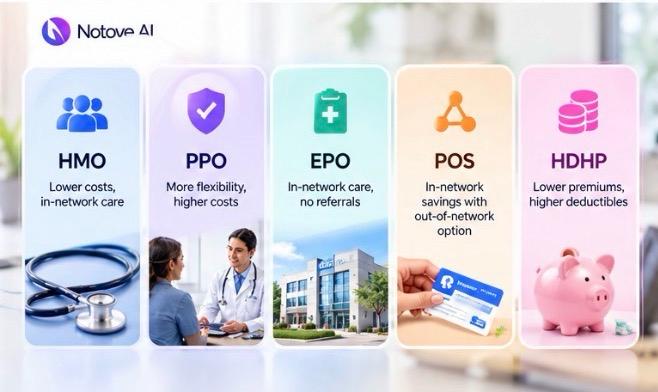
These four Health Insurance Plans appear constantly in commercial coverage. Each one handles specialist access and out-of-network care differently.
HMO: Health Maintenance Organization
An HMO is built around a primary care provider, often called a PCP. The patient picks one PCP who coordinates all care. Seeing a specialist usually requires a referral from that PCP. Care outside the network is generally not covered, except in emergencies.
For billing staff, the referral is the item to chase. Without it, the claim may be denied or the patient may owe the full charge.
PPO: Preferred Provider Organization
A PPO gives patients the most freedom. They can see any in-network provider without choosing a PCP. Referrals are generally not required for specialists. Out-of-network care is often covered, but the patient pays a higher share.
Your focus shifts from referral tracking to network checking. Confirm the provider is in-network on the date of service, because the cost changes if not.
EPO: Exclusive Provider Organization
An EPO sits between an HMO and a PPO. Patients usually skip the PCP and referrals. However, the plan generally pays only for in-network care, with emergencies as the usual exception.
This catches patients off guard. They hear “no referral needed” and assume any specialist is fine. Tell patients at scheduling that the provider must be in the network.
POS: Point of Service
A POS plan blends HMO and PPO rules. The patient picks a PCP and usually needs referrals for specialists. Unlike an HMO, the plan may cover out-of-network care at a higher cost.
Treat a POS patient like an HMO patient first. Collect the referral, then check network status.
How High Deductible Health Insurance Plans Change Patient Payments
A high deductible health plan, or HDHP, is not a separate network type. An HMO, PPO, EPO, or POS can all be built as an HDHP. What changes is the money.
The patient pays the full allowed amount until the deductible is met. The allowed amount is the rate your payer contract permits. Many HDHP members also hold a health savings account, or HSA. An HSA is a tax-advantaged account used for medical costs.
Expect more patient balances early in the year. Collect estimated responsibility at the visit when your payer contract allows it.
Medicare Advantage and Medicaid Health Insurance Plans
Medicare Advantage delivers Medicare benefits through private insurers. Most of these plans operate as HMOs or PPOs, so the rules above apply. The patient presents the plan’s card instead of the red, white, and blue Medicare card.
Original Medicare rarely requires prior authorization. Medicare Advantage plans often do. Many state Medicaid programs also run through managed care organizations that behave like HMOs. Confirm your state’s rules before assuming either way.
How Different Health Insurance Plans Handle the Same Specialist Visit
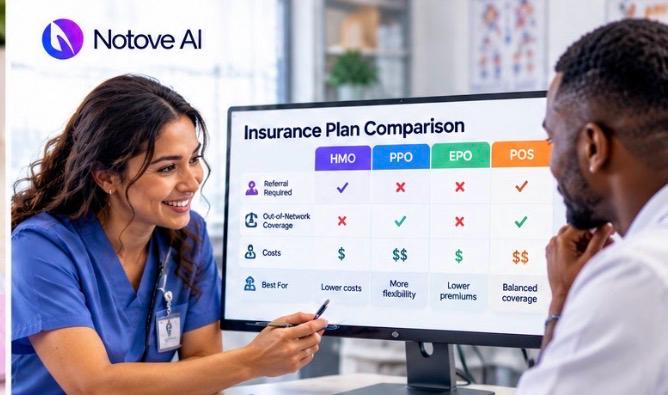
Here is how one scheduling request plays out across six coverage situations. Use it in new hire training to test whether the rules have stuck.
| Coverage situation | What the patient does | What usually happens |
|---|---|---|
| HMO with no referral on file | Books a specialist directly | The claim may deny, or the patient may owe the full charge |
| PPO with an in-network specialist | Books a specialist directly | No referral is needed, and the claim pays at in-network rates |
| EPO with an out-of-network specialist | Books a specialist directly | The plan generally denies the claim, except for emergencies |
| POS with a referral and an out-of-network specialist | Follows the PCP referral | The plan may pay, but the patient owes a higher share |
| HDHP with the deductible not yet met | Books a visit in January | The patient pays the allowed amount until the deductible is met |
| Medicare Advantage HMO with an MRI ordered | Schedules the scan | The plan may require authorization before the scan happens |
Verification Habits That Work Across Health Insurance Plans
Verification is where every plan rule becomes a task. These five checks apply to all Health Insurance Plans:
- Confirm active coverage on the date of service. A card can be valid but inactive.
- Ask for the exact plan type. Products from one payer follow different rules.
- Check referral and authorization needs for the specific procedure. Rules attach to services, not just to plans.
- Verify network status for the provider and the facility. A mismatch can raise the patient’s cost.
- Ask whether a second plan exists and which pays first. The wrong billing order causes rejections.
Document every answer with the date, the representative’s name, and a call reference number. That record protects your clinic when a payer disputes what was said.
Clean verification protects the claim downstream. See what medical claims are and how the claims process actually works for the next step. Patients notice the difference too. Surprise bills hurt trust, and patient experience in healthcare is now a business metric.
Small clinics rarely have spare hours for all of this by hand. Many are exploring what healthcare AI actually means for specialty clinics to lighten the load.
Final Thoughts on Health Insurance Plans for Billing Teams
Health Insurance Plans are less about memorizing acronyms and more about knowing which rule applies to which patient. Three habits make the biggest difference:
- Check the plan type first. It decides whether a referral or an in-network provider is required.
- Confirm the specific service. Authorization rules attach to procedures. A covered service can still be denied without approval.
- Record every answer. Your notes become the proof you need when a denial goes to appeal.
Authorization work is where plan rules often eat up staff hours. Notove AI uses AI agents to gather documentation, prepare payer requests, and track authorization status for clinics. Staff still review and submit each request. If your team is tired of chasing approvals by phone and portal, join the waitlist for early access.
Frequently Asked Questions About Health Insurance Plans
What are the main types of Health Insurance Plans?
The four main network designs are HMO, PPO, EPO, and POS. An HMO requires a PCP and referrals. A PPO allows direct specialist visits and out-of-network care at a higher cost. An EPO skips referrals but covers in-network care only. A POS plan blends HMO and PPO rules. An HDHP describes deductible size and can sit on top of any of these.
What is the difference between an HMO and a PPO for billing purposes?
An HMO usually needs a PCP referral and in-network care. A PPO usually needs neither. For billing staff, HMO work centers on tracking referrals. PPO work centers on confirming network status and the patient’s cost share.
Do all Health Insurance Plans require prior authorization?
No. Requirements vary by plan and by service. Many plans keep a list of services that always need approval. Original Medicare rarely requires prior authorization, while Medicare Advantage plans often do. Check the payer’s list for each procedure code.
What is the difference between a referral and a prior authorization?
A referral is a PCP’s recommendation to see a specialist. A prior authorization is the payer’s approval for a specific service. A plan may require one, both, or neither. Neither one guarantees payment.
How can billing staff confirm a patient’s plan type?
Treat the insurance card as a starting point. Confirm the plan type through the payer portal or a verification call. Ask directly whether the plan is an HMO, PPO, EPO, or POS. Record the answer in the patient’s file.