
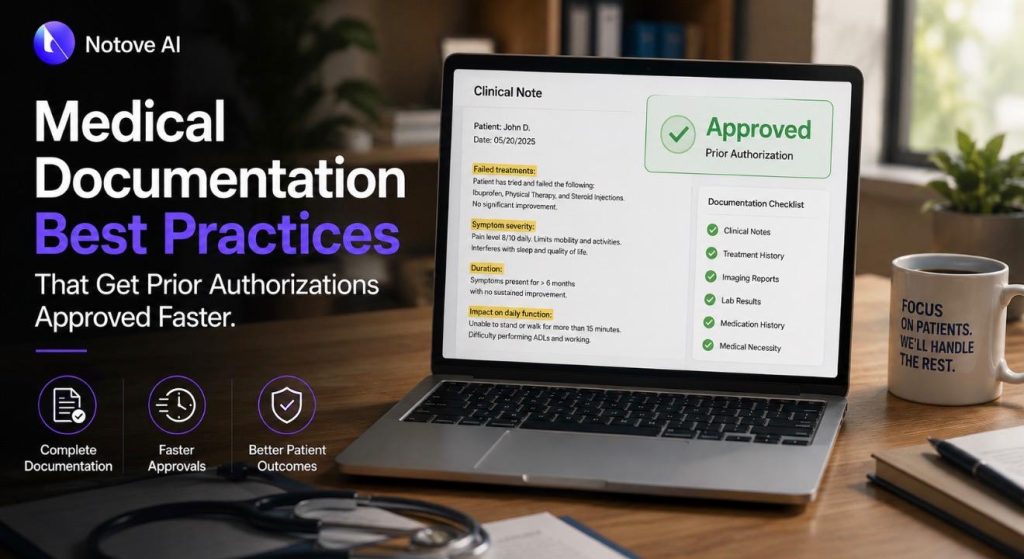
Medical Documentation is the single biggest lever a clinic has over how fast a prior authorization gets approved, and most front office teams already know it. The MRI that sits in pending status for nine days, the injection that bounces back for “insufficient clinical information,” the specialty drug that needs three phone calls before anyone tells you what was actually missing: almost every one of those delays traces back to a documentation gap that was preventable at the point of care.
This article is not about payer politics or appeals strategy. It’s about what your clinic can control: what gets written down, when, and how it’s packaged before it ever reaches a reviewer’s desk.
Why Prior Authorizations Get Delayed (And How Documentation Is Usually the Culprit)
Every clinic feels the same pain points: staff burning hours chasing chart notes, patients waiting on care they’ve already been told they need, and revenue sitting in limbo while a request gets pended. When you dig into why a request stalls, the answer is rarely that the payer is being unreasonable. It’s usually that the submitted packet was incomplete, inconsistent across notes, or written for the chart instead of for the payer.
“Faster approvals” doesn’t mean every request sails through with zero scrutiny. It means fewer back-and-forths, fewer pended cases, fewer denials for missing information, and more requests that clear on the first submission. That’s a realistic, measurable goal, and it starts with how the clinical story gets documented. If you want a deeper look at how widespread this problem has become across specialties, the prior authorization crisis in 2026 breaks down just how much administrative load this is adding to clinics nationwide.
Think Like a Payer: What Reviewers Need to Approve on the First Pass
A payer reviewer is checking four things in sequence: is this medically necessary, is it the correct indication for the requested service, does it align with the payer’s coverage criteria, and is the packet actually complete enough to make a decision without calling the office. Miss any one of those and the request gets pended or denied.
This is where a lot of practices stumble without realizing it. The note that satisfies a clinical chart review is often not the same note that satisfies a payer. A great progress note can still fail a prior authorization if it doesn’t explicitly connect the dots a reviewer is trained to look for. Medical Documentation written for continuity of care and documentation written to support an authorization request are two different jobs, even when they describe the same visit. And the bar moves: the same CPT code can require different supporting evidence from one plan to the next, even within the same payer.

The Fastest Approvals Start Before the Order: Pre-Visit and Ordering Workflows That Prevent Missing Evidence
The best time to capture strong documentation is while the patient is still in the room, not three days later when someone is trying to reconstruct the visit from memory. A pre-charting checklist helps here: confirm the problem list is current, the medication list and allergies are accurate, relevant history is pulled forward, and any prior imaging or test results are noted rather than just referenced.
At the order entry step, the clinician should include a specific suspected diagnosis with appropriate ICD-10 specificity and a clear clinical question the requested test or procedure is meant to answer. Vague orders create vague documentation, and vague documentation is exactly what triggers a request for more information. This works best as a shared responsibility: the clinician captures the clinical story accurately, and staff validate that the payer’s specific requirements are met before anything goes out the door.
Core Medical Documentation Elements That Speed Up Approvals (The Non-Negotiables)
Across most payers and most specialties, a small set of documentation elements shows up again and again as the difference between an approval and a pend. Think of this as the floor, not the ceiling, for any request.
| Documentation Element | What a Reviewer Is Actually Checking | Weak vs. Strong Example |
|---|---|---|
| Symptom onset and duration | Whether the timeline matches a chronic or acute pattern that fits the requested service | Weak: “ongoing pain.” Strong: “low back pain for 14 weeks, worsening over the last 3” |
| Functional impairment | Real-world impact on daily activity or work, not just a pain score | Weak: “pain 7/10.” Strong: “unable to stand longer than 10 minutes, missed 6 workdays” |
| Objective findings | Exam findings, vitals, neuro deficits, ROM, special tests, or abnormal labs tied to the diagnosis | Weak: “exam unremarkable.” Strong: “positive straight leg raise at 30 degrees, right side” |
| Assessment and differential | A diagnosis explicitly linked to the findings above, not a symptom label | Weak: “pain, unspecified.” Strong: “lumbar radiculopathy, suspected L4-L5 involvement” |
| Reason for the requested service | What clinical decision the test or procedure will actually change | Weak: “MRI requested.” Strong: “MRI to evaluate for disc herniation prior to surgical referral” |
| Relevant comorbidities | Risk factors that increase medical necessity, such as cancer history or anticoagulation | Weak: omitted entirely. Strong: “history of anticoagulant use, increasing surgical risk” |
Keep a version of this table at the front desk or in your EHR’s smart phrase library. It earns its place as a standalone reference, not because it summarizes this article, but because it’s the checklist a medical assistant can run through in under two minutes before a chart gets sent for authorization.
Show Medical Necessity With a Clean Story: A Simple Template That Works
Reviewers scan, they don’t read. A medical necessity narrative works best as a tight, skimmable structure: patient summary, symptoms and duration, prior treatments tried, objective findings, how this aligns with guideline criteria, and the requested service with a clear reason for why it’s needed now.
Short paragraphs and bullets beat dense blocks of prose every time. And there’s a handful of phrases that quietly sink requests: “rule out,” “pain,” and “MRI requested” with no justification are all red flags to a trained reviewer because they signal the request wasn’t built around medical necessity. Replace them with specific, outcome-oriented language: “evaluate for disc herniation given positive neuro findings” does the job a vague “rule out” never will.
Documenting Conservative Treatment Correctly (So Payers Can’t Say “Not Tried”)
If there’s one missing element that shows up more than any other in pended requests, it’s proof that conservative treatment was actually attempted. Saying “patient tried PT” isn’t documentation, it’s a summary with no evidence behind it.
What payers want to see is specific: which modality, how many sessions, over what time frame, whether the patient was adherent, what the response was, and why it ultimately failed or wasn’t tolerated. That means PT visit dates, a documented home exercise program, NSAID name with dose and duration, injection dates with outcomes, and any activity modifications attempted. When conservative care genuinely isn’t appropriate, that needs its own documentation too, with red flags or clinical exceptions like neurological deficits or suspected malignancy spelled out clearly rather than implied.
Match the Packet to the Request Type: Imaging vs Procedures vs Medications
One-size-fits-all documentation is one of the most common reasons clean clinical notes still trigger a denial. Imaging requests need the clinical question, exam findings, prior imaging results, and a clear explanation of why a less intensive imaging option wouldn’t be sufficient. Procedures and surgeries need the indication, severity grading, prior therapies tried, imaging or lab support, and the planned technique or site. Specialty medications need diagnosis confirmation, evidence of prior step therapy, relevant lab monitoring, and baseline severity metrics where applicable.
Specialty-specific patterns matter here too. Cardiology and orthopedic requests in particular tend to get flagged for very specific, repeatable reasons, and if your clinic handles a high volume of either, it’s worth building a dedicated checklist; this guide on how to reduce prior authorization denials for cardiology and orthopedic practices walks through what those service lines need that general checklists tend to miss.
Payer-Specific Requirements: How to Avoid Denials Caused by “Wrong Form, Wrong Info, Wrong Place”
A surprising number of denials have nothing to do with medical necessity at all. They happen because the wrong form was used, a required field was left blank, the CPT and ICD-10 codes didn’t match, or the NPI or site of service was missing. None of that reflects on the quality of care; it reflects on process.
The fix is a living payer matrix: payer, service, required documentation, submission channel, and expected turnaround, all in one place your team actually maintains. Standardizing how attachments are named, such as “PT Notes 03-2026” or “X-ray Report 05-2026,” helps reviewers find evidence quickly instead of digging through an entire chart dump. Submitting the most relevant pages instead of the whole record is almost always faster and cleaner. How you submit matters too: clinics that have compared electronic prior authorization vs manual submission consistently find that electronic channels cut down on exactly this category of avoidable, non-clinical denial.
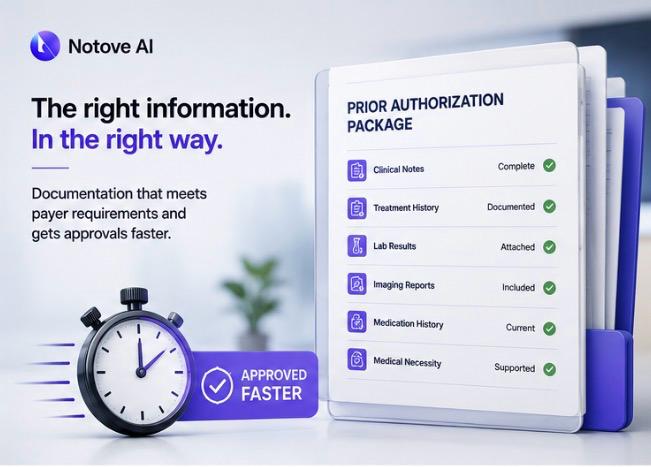
Common Documentation Mistakes That Trigger Denials (And the Quick Fixes)
The repeat offenders are predictable: a non-specific diagnosis code, no documented severity or functional impact, missing duration, no detail on prior treatment, outdated notes, or conflicting information between two visits. Reviewers are specifically trained to flag contradictions like a laterality mismatch, a different diagnosis recorded across visits, a missing signature or date, or an incomplete problem list.
Most of these are fixable in minutes with an addendum, an updated problem list, a laterality correction, or an added date and outcome on a prior treatment. A two-minute pre-submit audit, run every single time before a packet goes out, catches the majority of these before they ever reach a payer. For a broader view of what’s driving denials across the board right now, the top reasons prior authorizations get denied and how to prevent each one is a useful companion checklist to keep next to your own.
Build a Repeatable “PA-Ready” Documentation Workflow in Your Clinic
Good documentation habits don’t stick if they live in one person’s head. A repeatable workflow moves from order, to documentation capture, to packet assembly, to submission, to tracking, with clear roles at each step: provider, MA or nurse, authorization specialist, and billing or coding support.
Templates, macros, smart phrases, and internal service-level agreements turn this from a one-off effort into a standard operating procedure. And it only improves if someone is tracking the right numbers: first-pass approval rate, average time to approval, denial reasons broken down by payer and service, and the hours staff are spending on rework. Without that data, it’s hard to know whether your documentation changes are actually working.
How Automation Helps: Assembling the Right Evidence Fast (Without Adding Work for Clinicians)
In an ideal workflow, software detects which procedures need prior authorization, gathers the relevant evidence directly from the EHR, drafts a payer-specific request, and guides staff through submission and status tracking, all with a human reviewing and approving before anything goes out. That human-in-the-loop step matters: staff still approve the request, clinicians still focus on care, and nothing submits automatically without a second set of eyes.
This is exactly the gap Notove AI was built to close for small and mid-sized clinics: reducing the manual hunting for chart evidence, improving completeness before submission, and cutting down on denials caused by missing or mismatched documentation. If you’re curious how much time this kind of approach can realistically save, this breakdown of how prior authorization automation cuts approval times by 80 percent is worth a look. Implementation doesn’t have to be disruptive either; tools built for this should require no installation, a quick setup, and full HIPAA compliance from day one.
A Simple Closing Playbook: What to Change This Week to Get Faster Approvals
Start small and specific rather than trying to fix everything at once. Adopt the medical necessity template for your most common requests, set a clear standard for documenting conservative care, build out a payer matrix for your top payers, run the two-minute pre-submit audit on every packet, and start tracking denial reasons by category. Pick your two or three highest-volume services first, MRI, injections, and specialty medications are common starting points, and refine the process there before rolling it out further.
None of this requires a system overhaul. It requires consistency, and a willingness to write Medical Documentation for the reviewer who’s going to read it, not just for the chart. If your team wants help putting this into practice without adding more administrative work to an already full day, Notove AI is built specifically to gather the right documentation, assemble payer-specific requests, and support your staff through submission. You can learn more and join the early access waitlist at notove.com.

Frequently Asked Questions
What is the most common documentation mistake that delays prior authorizations?
The most frequent issue is failing to clearly document that conservative treatment was tried and failed before requesting a more advanced service. A note that simply says a patient “tried physical therapy” without dates, duration, adherence, or outcome rarely satisfies a payer’s medical necessity criteria, even when the treatment genuinely happened.
How specific does a diagnosis code need to be for a prior authorization request?
It needs to be as specific as the clinical picture allows. Non-specific or unspecified ICD-10 codes are one of the top reasons requests get pended for additional information, because they don’t give a reviewer enough detail to confirm medical necessity against payer guidelines.
Does the same clinical note work for both patient care and a prior authorization request?
Not always. A note can be clinically thorough and still fail to support an authorization if it doesn’t explicitly connect symptoms, prior treatment, objective findings, and the reason for the requested service. Payer-facing documentation often needs to restate or reorganize information from the chart so a reviewer can find it quickly.
Why do prior authorization requirements differ even within the same insurance payer?
Requirements can vary by specific plan, not just by payer, because coverage criteria are often set at the plan or product level rather than uniformly across an entire insurer. The same CPT code may require different supporting evidence depending on the patient’s exact plan.
Can better documentation alone reduce prior authorization denial rates?
Yes, in most clinics it’s the single biggest factor within their control. Payer policy and coverage criteria are largely fixed, but incomplete, inconsistent, or non-specific documentation is the most common preventable cause of denials and pended requests, which means it’s also the area where clinics see the fastest improvement once they standardize their process.