

Prior Authorization Staff at independent practices are stretched thinner than ever. Every order can trigger a chain of portal logins, faxes, and phone holds. For a hospital system, this workload gets spread across dedicated revenue cycle teams. For a small clinic, it often lands on one or two people who already wear five other hats.
That imbalance is starting to shift. AI agents are stepping into the repetitive parts of prior authorization work, freeing Prior Authorization Staff to focus on the requests that actually need a human judgment call. This article breaks down why manual prior authorization is breaking, where AI agents fit, and what to look for before you bring one into your clinic.
Why Prior Authorization Staff at Independent Practices Are Overwhelmed
Prior authorizations, referral letters, and documentation requests eat into clinical and administrative time every single day. That time comes directly out of patient care. Delayed authorizations mean delayed treatment, and delayed treatment means frustrated patients.
Independent practices feel this pressure harder than large hospital systems. Lean teams mean fewer dedicated revenue cycle resources. One person might handle scheduling, billing, and prior authorizations in the same shift.
Prior Authorization Staff typically handle intake, payer portal navigation, documentation checklists, follow-up calls, and faxing. It is detailed, repetitive, and unforgiving work. One missing field can delay a case for weeks.
The shift happening now is not about replacing people. It is about replacing the repetitive steps that consume their day. AI agents handle the paperwork trail so Prior Authorization Staff can focus on exceptions, patient coordination, and appeals that actually need a trained eye.
What an AI Agent Means in Prior Authorization (Not Just a Chatbot)
An AI agent in this context is software that can detect when a prior authorization is needed, gather supporting evidence, prepare the forms, and track the request through to approval. That is very different from a chatbot that answers questions.
It is also different from a basic RPA macro or a generic large language model. A true AI agent combines autonomy with workflow context. It keeps an audit trail. It knows when to pause and hand a decision back to a person.
Human oversight stays built into the process. Prior Authorization Staff review the prepared request before it goes out. Clinicians sign off when clinical judgment is required.
AI agents are strongest at repeatable administrative workflows. Complex clinical nuance still belongs with the clinician. That division of labor is what makes the technology trustworthy rather than risky.
Where Manual Prior Authorization Breaks Down
Six failure points repeatedly show up in independent practices, and each one adds cost in time, staff overtime, or lost patients.
The first is detection. A procedure gets ordered, but nobody catches that it needs prior authorization until scheduling is already underway. The second is the documentation scavenger hunt, where staff dig through EHR notes, imaging, and prior treatment records to build a case.
The third failure point is payer variance. Every payer has its own forms, portals, and medical policy language, and none of it lines up cleanly. The fourth is incomplete submissions, often caused by a mismatched ICD-10 or CPT code, or missing clinical evidence.
The fifth is the status black hole, where nobody knows if a request was received, denied, or simply stuck. The sixth is the rework loop that follows a denial, which means new documentation, an appeal letter, and another wait.
Each of these failure points has a direct cost. It shows up as hours per request, delayed scheduling, staff overtime, and patients who quietly leave for another practice.
How AI Agents Replace the Manual Steps Without Replacing Accountability
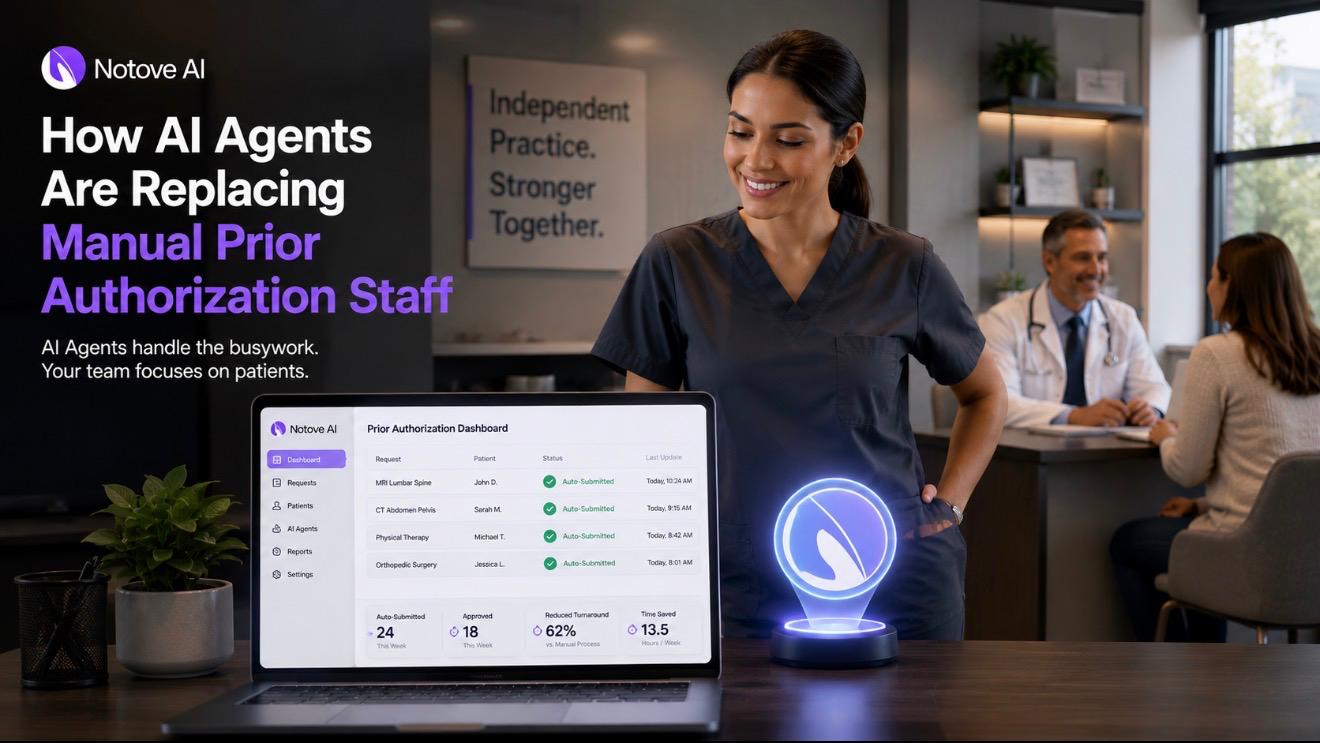
The manual prior authorization workflow can be mapped step by step to an agent-based version of the same process. The repetitive, non-clinical tasks get automated. Review and submission stay as the human control point.
This matters most for small clinics because it removes handoffs. Fewer handoffs mean fewer chances for something to fall through the cracks. It also reduces dependence on one person’s tribal knowledge of how a specific payer likes its forms filled out.
Step 1: Authorization Detection Right When the Order Is Created
An AI agent flags procedures likely to require prior authorization based on payer and procedure type, right at the point of order. That early flag means fewer scheduling surprises later.
Look for configurable detection rules and clear notes explaining why a case was flagged. That transparency builds trust with Prior Authorization Staff who still need to verify the call.
Step 2: Documentation Assembly From the EHR Without Chasing Charts
Instead of staff digging through notes, the agent pulls relevant history, prior treatments, imaging reports, and labs directly from the EHR. It checks that evidence against payer criteria for medical necessity.
The outcome is fewer incomplete packets and fewer back-and-forth messages with payers. That alone can cut days off a typical request.
Step 3: Payer Specific Request Preparation
Every payer wants something slightly different, and the agent prepares the forms, letters, and attachment lists to match. Naming conventions and versioning stay consistent across every request.
This consistency matters because it reduces clerical errors that Prior Authorization Staff would otherwise catch during a rushed review. For a deeper look at how this plays out in radiology, see how prior authorization for radiology clinics cuts approval times from days to hours.
Step 4: Prior Authorization Staff Review and Submit in Seconds
This is the safety checkpoint. Prior Authorization Staff validate the prepared request, make any edits, and submit it. The role shifts from data entry clerk to authorization supervisor.
That shift in role is often the biggest morale change clinics report. Staff spend less time typing and more time making judgment calls.
Step 5: Submission Tracking and Follow Ups
Once submitted, the agent tracks approval status, denial notices, and deadlines automatically. It sends reminders before a follow-up window closes.
The result is fewer missed follow-ups and better communication with patients waiting on approval. Staff no longer have to guess where a request stands.
What This Looks Like in a Real Independent Practice
Radiology Clinic: MRI Order That Usually Stalls at Scheduling
In a manual workflow, the prior authorization requirement often gets missed until scheduling. Staff then scramble to pull notes and submit through a payer portal, followed by repeated calls.
With an AI agent, the requirement is detected the moment the order is placed. Imaging indications and conservative care history get assembled automatically, and staff simply review and submit.
Orthopedic Practice: Procedure Authorization With Conservative Therapy Requirements
Orthopedic cases often stall because physical therapy history, medication trials, or prior imaging go missing from the packet. That gap is a common cause of denial.
An AI agent pulls prior PT notes, injection history, and imaging automatically. It flags missing elements before the request ever reaches a payer.
Cardiology Group: Testing Authorization Across Multiple Payers
Cardiology practices juggle diagnostic testing requests across many payers, each with its own policy quirks and portal. Status chasing becomes a full-time job on its own.
An AI agent prepares payer-specific requests and centralizes tracking in one dashboard. Staff step in only when a request needs a human decision.
Why AI Agents Are a Better Fit Than Hiring More Prior Authorization Staff

Hiring more staff sounds like the obvious fix, but it comes with real friction. Recruitment is slow, training takes months, and payer requirements change constantly.
More staff can also mean more handoffs and less consistency. Two people rarely fill out the same form exactly the same way, and that inconsistency shows up as denials.
AI agents offer leverage instead. They handle volume spikes without a matching increase in headcount, and the workload reduction can reach up to 80 percent. For a full breakdown of the savings, see how clinics reclaim 10 hours per week by automating this process.
| Task | Manual Process | AI-Assisted Process |
|---|---|---|
| Authorization detection | Often missed until scheduling | Flagged at order creation |
| Documentation gathering | 30 to 60 minutes per case | Assembled automatically in minutes |
| Payer form preparation | 20 to 40 minutes per payer | Pre-filled, staff reviews only |
| Status tracking | Manual portal checks, phone calls | Automated dashboard with alerts |
| Denial rework | Hours of new documentation | Missing items flagged before submission |
What to Evaluate in a Prior Authorization AI Agent
Workflow Capabilities That Actually Move the Needle
The must-haves are authorization detection, documentation assembly, payer-specific preparation, guided submission, and tracking with alerts. Anything missing one of these is not a complete workflow tool.
Nice-to-haves include denial reason clustering, appeal packet drafting, and analytics broken down by payer and procedure. These extras help a practice improve over time, not just process the current backlog.
Safety, Compliance, and Control
HIPAA compliance is non-negotiable, along with encryption, secure data handling, and audit logs. Role-based access should clearly define what the AI can and cannot do on its own.
Human-in-the-loop review before submission should be the standard operating model, not an optional add-on. If a vendor cannot explain their review checkpoint clearly, that is a red flag.
Setup and Adoption in a Small Clinic
Look for a tool with no installation, a web-based interface, and a setup process measured in minutes rather than weeks. Training should require minimal change management.
Onboarding support should include templates and specialty-specific pathways. Practices that skip this step often see slower adoption from Prior Authorization Staff who are already stretched thin.
How Notove AI Stands Out for Independent Practices
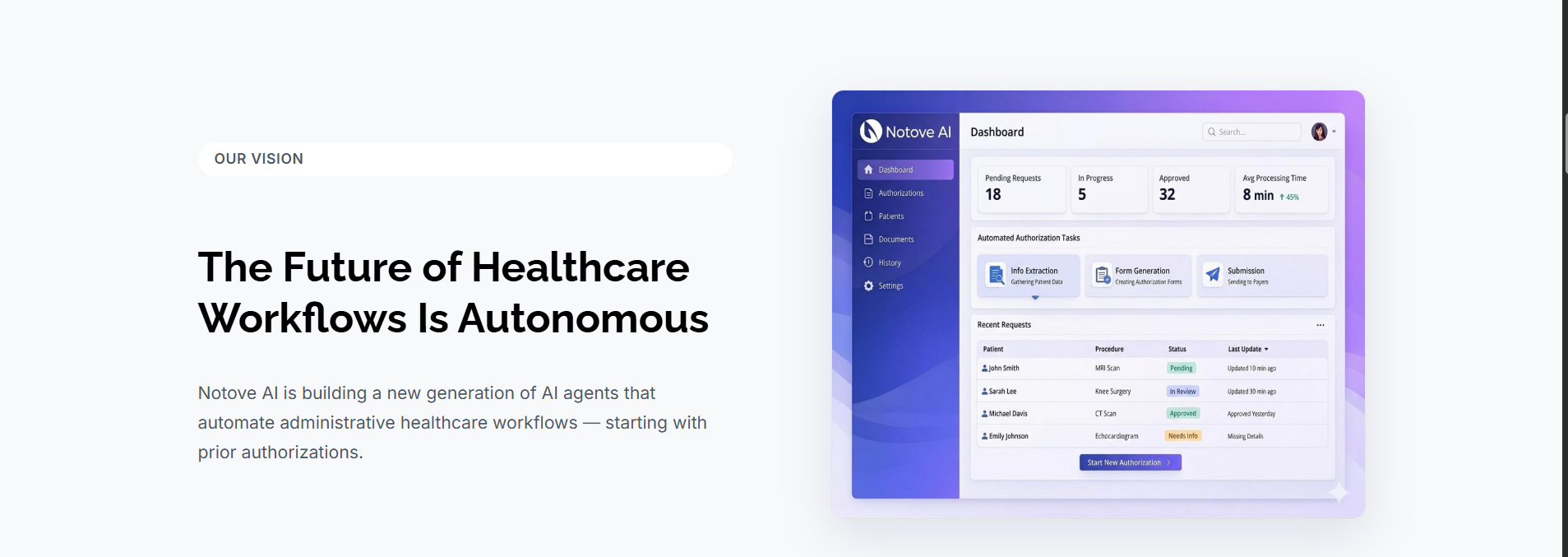
Notove AI was built specifically for the administrative burden facing Prior Authorization Staff at independent and specialty clinics. It follows a five-step chain: authorization detected, documentation collected, request prepared, staff reviews and submits, and submission tracked.
Clinics using the platform report workload reductions of up to 80 percent, fewer denials, and more than 10 hours per week returned to patient care. Reported burnout reduction reaches 60 percent, with overhead running three times more efficient.
The platform is built for radiology, orthopedic, cardiology, and oncology practices, along with primary care. It fits into existing workflows without requiring a new EHR or IT overhaul. Practices handling complex treatment approvals can also review how prior authorization automation protects patient access in oncology, where delays carry the highest stakes.
Early access includes priority onboarding, exclusive pricing, and three months free for the first 500 physicians who join.
A Practical Rollout Plan for Implementing an AI Agent
Start with one high-volume service line, such as MRI orders or a payer-heavy segment of your practice. Trying to automate everything at once tends to overwhelm both staff and the system.
Define success metrics before launch. Turnaround time, denial rate, touches per request, and hours saved per week are all good starting points to track.
Set a clear review process, including a staff checklist, escalation rules, and clinician sign-off points where needed. Expand to more procedures and payers only after two to four weeks of stable performance.
Communicate the change internally as assistive automation, not staff replacement. Assigning one internal owner to the rollout keeps accountability clear. For a full walkthrough with no IT team required, see how to implement prior authorization AI at your clinic.
Common Concerns and Honest Answers
Job displacement is usually the first worry, and it is a fair one. In practice, AI handles the repetitive prep work while Prior Authorization Staff keep authority over review, submission, and appeals.
Accuracy concerns are addressed through the human review checkpoint built into every workflow step. Payer acceptance has not been a barrier, since the final submission still comes from a licensed staff member.
EHR integration questions come up often, and most agents are designed to work alongside existing systems rather than replace them. Liability stays with the practice and clinician, exactly as it does today, since AI prepares but does not authorize.
Data security concerns should be met with clear answers on encryption, audit logs, and HIPAA compliance. Any vendor unwilling to explain these details in plain language deserves a second look.
Conclusion: The New Prior Authorization Model for Independent Practices
Manual prior authorization breaks down at detection, documentation, payer variance, submission completeness, tracking, and denial rework. Every one of those failure points adds hours to a process that should take minutes.
AI agents replace the manual steps, not clinical judgment. Prior Authorization Staff keep the final say while the repetitive administrative load moves off their plate.
The result is faster approvals, fewer denials, less burnout, and more time back with patients. If your practice is ready to see this in action, visit Notove AI or reach out to the team to request a walkthrough.
Frequently Asked Questions
What do Prior Authorization Staff actually do at an independent practice?
Prior Authorization Staff manage intake, payer portal submissions, documentation checklists, follow-up calls, and faxing. They confirm medical necessity criteria and track each request until it reaches a decision.
Will AI agents replace Prior Authorization Staff entirely?
No. AI agents automate the repetitive preparation work, while Prior Authorization Staff still review, edit, and submit every request. Clinical sign-off stays with licensed staff and physicians.
How much time can an AI agent save on prior authorizations?
Independent practices using AI-assisted workflows report workload reductions of up to 80 percent. Many clinics reclaim more than 10 hours per week previously spent on manual paperwork.
Is an AI prior authorization agent HIPAA compliant?
A properly built AI agent should include enterprise-grade encryption, secure data handling, audit logs, and regular security reviews. Always confirm HIPAA compliance directly with the vendor before adoption.
Do independent clinics need a new EHR to use an AI prior authorization agent?
No. Most AI agents are designed to work alongside existing EHR systems rather than replace them. Integration details are typically confirmed during onboarding with the vendor.
How long does it take to set up an AI prior authorization agent?
Many platforms require no installation and can be set up within minutes since they run entirely in the browser. Training is designed to fit existing workflows with minimal disruption.