

Automating Prior Authorizations is quickly becoming the line between a clinic that runs smoothly and one that drowns in paperwork. Anyone who has managed a PA queue knows the feeling. The queue never empties. Staff bounce between phone calls, payer portals, and fax machines just to move one request forward. Rework piles up when a form comes back incomplete or a payer changes a rule overnight.
PA work covers more than most people realize. It includes verifying requirements, gathering supporting documentation, drafting letters, filling out payer specific forms, submitting requests, and tracking their status through approval or denial. Every one of those steps can stall for reasons outside a clinic’s control. Interruptions and context switching quietly multiply the time each task actually takes. Staff often chase providers for missing notes because payer rules are inconsistent from one insurer to the next.
The operational pain has a direct financial cost. Delayed care means delayed revenue. Denials mean rework and resubmission. Burned out staff eventually leave, and replacing them is expensive. This article walks through how to quantify that cost, and how clinics that pursue Automating Prior Authorizations are reclaiming more than 10 hours per week.
What Automating Prior Authorizations Actually Means
Automating Prior Authorizations in practical terms means using AI to detect which procedures need authorization, assemble documentation, prepare the request, and guide submission. It is not the same as full autopilot. Human review still matters at every stage. A clinician or authorization specialist should always confirm accuracy before anything is submitted to a payer.
This is different from basic templates or simple robotic process automation. Payer specific requirements shift constantly, and mapping clinical evidence to those requirements is the hard part. Automation fits in three places. It helps before submission by preparing documentation. It helps during submission by guiding staff through payer specific steps. It helps after submission by tracking status and flagging follow ups.
A quick myth to address directly. Automation will not fix a poorly written clinical note. What it will do is flag exactly what is missing before a request goes out the door.
The ROI Framework Clinics Should Actually Use

Before buying another tool that “feels helpful,” clinics need a real framework. ROI from Automating Prior Authorizations comes from five places. Time saved on repetitive tasks. Denials avoided through more complete submissions. Faster approvals that keep schedules full. Lower overhead from reduced hiring pressure. A better experience for patients waiting on care.
Hours saved alone is an incomplete measure. Denials and approval speed directly affect revenue and patient outcomes. The right approach is to measure a baseline first, for two to four weeks, before assuming any number. Track average minutes per PA, total PAs per week, denial rate, and resubmission rate.
Once you have that baseline, convert it into dollars. Use loaded hourly rates, opportunity cost of clinician time, avoided overtime, and reclaimed appointment slots. This is bottom funnel thinking. A tool should be chosen based on measurable outcomes, not general claims about artificial intelligence.
Where the 10+ Hours Per Week Actually Comes From
A time audit makes the hidden cost visible. Break the PA workflow into stages. Each one drains a specific amount of time, and the ranges below reflect typical clinic experience rather than fixed numbers.
| PA Workflow Stage | Typical Minutes per Request | Common Cause of Delay |
|---|---|---|
| Requirement check | 5 to 15 | Payer rules change without notice |
| Chart digging for evidence | 10 to 25 | Documentation scattered across the EHR |
| Letter drafting | 10 to 20 | No standard template per payer |
| Form filling | 8 to 15 | Payer specific fields vary widely |
| Submission and confirmation | 5 to 10 | Portal friction or fax delays |
| Follow up and tracking | 10 to 30 | No centralized status view |
A small specialty clinic handling 40 PAs a week can easily reach 30 to 40 minutes per request once every stage is counted. That adds up past 10 hours weekly, without including the extra time clinicians spend when pulled in for last minute documentation requests.
Hard Dollar ROI Without Sacrificing Compliance
Cost buckets in a PA workflow include admin labor, clinician time spent fixing documentation, overtime, temporary staffing, and outsourcing fees. Automating Prior Authorizations reduces the handling time per request, which frees up capacity before a clinic needs to hire another full time employee.
Compliance benefits come along with the savings. Consistent packets, standardized letters, and a clear audit trail showing what was submitted and when all support audit readiness. Fewer missed fields and fewer inconsistent narratives mean fewer last minute edits under pressure.
A simple calculation clinics can run themselves: multiply hours saved per week by loaded hourly rate, multiply that by 52 weeks, then subtract the software cost. What remains is the net ROI for the year.
Revenue ROI From Faster Approvals
Every day a PA sits in limbo is a day that pushes back a procedure. Delays lead to postponed treatments, patient drop off, scheduling gaps, and slower claims. Shorter cycle time supports predictable scheduling and better throughput across the clinic.
This matters most in specialties like imaging, orthopedics, cardiology, and oncology, where timing directly affects patient outcomes. Two metrics worth tracking closely are approval turnaround time and the rate of scheduled procedures that actually get completed. Automating Prior Authorizations helps prevent cases from getting stuck through better tracking and automatic reminders.
Denials ROI and the Easiest Win Available
Missing documentation is the most common and most preventable driver of denials. Incorrect form fields, unaddressed payer criteria, and outdated documentation round out the usual list. Every denial compounds into resubmission time, appeals, delayed care, and frustration for both staff and patients.
Automation improves first pass completeness through checklists and evidence extraction pulled directly from the chart. Track first pass approval rate alongside denial rate and resubmission rate, broken down by payer and procedure type. This is exactly where Notove AI adds value, through payer specific preparation, documentation assembly, and a staff review loop that keeps a human in charge of the final decision.
What to Look for in a Prior Authorization Automation Platform
A buyer checklist should stay tied to outcomes rather than features. Look for authorization detection, documentation assembly pulled from EHR context, payer specific forms and letters, submission assistance, and status tracking. For a full walkthrough of these criteria, this complete guide to AI prior authorization software breaks down what small and specialty clinics should prioritize.
Operational fit matters as much as features. A platform should require no installation, offer fast setup, and work alongside whatever EHR the clinic already uses. Governance is non negotiable. Look for HIPAA compliance, encryption, access controls, audit logs, and human in the loop review at every step. This breakdown of what to look for in a HIPAA compliant vendor covers the governance side in more depth.
Ask any vendor for a pilot plan, baseline metrics, and clear success criteria before committing. If you are comparing multiple platforms, this prior authorization software comparison for 2026 is a useful reference point.
How Notove AI Stands Out From Generic Tools
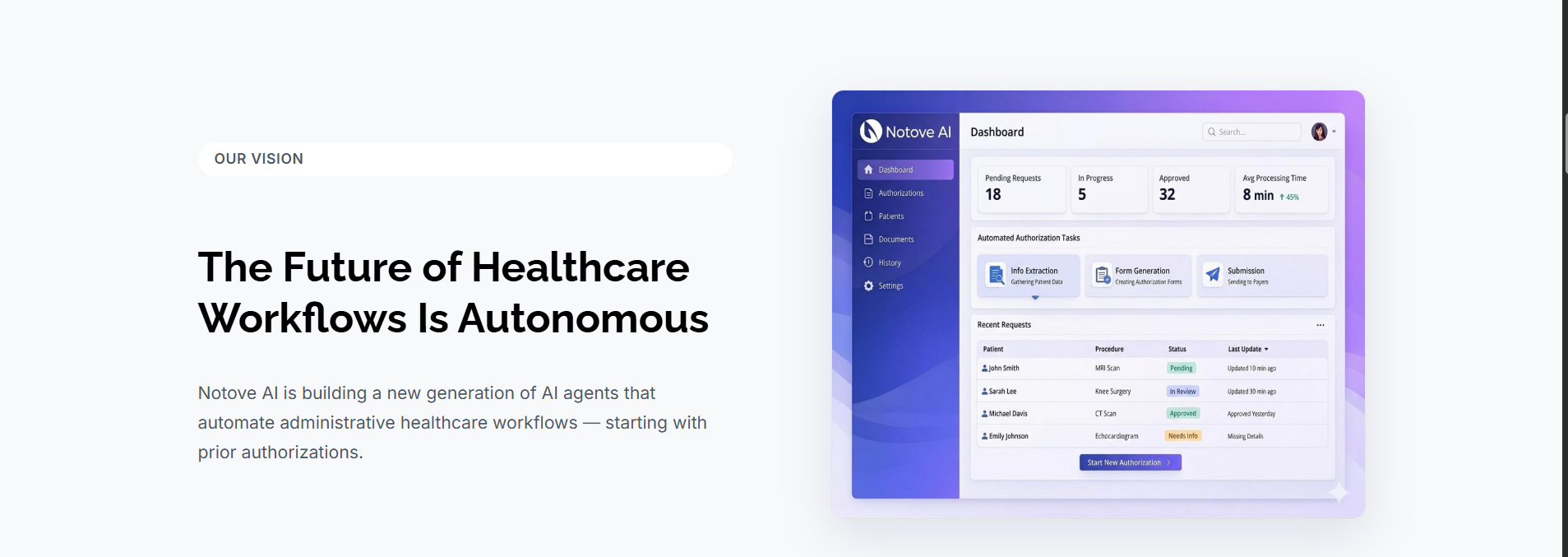
Notove AI is built specifically as an AI agent for prior authorizations, not a generic template tool. The workflow maps directly to each stage clinics already deal with daily. Authorization detection identifies procedures that need a PA. Documentation collection pulls clinical evidence from the EHR automatically. Request preparation builds payer specific forms. Staff review keeps a human approving before anything submits. Submission tracking follows the request through to a decision.
This reduces manual searching, cuts down on repetitive copy and paste work, and standardizes every packet that goes out. Unlike generic AI writers, Notove is trained specifically for healthcare administrative workflows. Every output is designed for review before submission, not for blind automation.
A Realistic ROI Example Clinics Can Calculate in Minutes
Here is a simple model any clinic can plug numbers into. Start with PAs handled per week, minutes spent per PA today, and a target reduction percentage. Add loaded hourly rate and hours currently lost to denial rework.
From those inputs, calculate hours saved per week, annual labor savings, and potential denial rework savings. Run the numbers at three levels, a conservative 30 percent reduction, a moderate 50 percent, and an aggressive 80 percent reduction in workload. If your baseline numbers resemble the time audit table above, a pilot is almost always worth running.
Implementation That Actually Sticks
Rollout works best when it starts small. Choose one or two high volume payers, or a single procedure type, before expanding further. Assign clear roles. A PA specialist should own daily execution, a clinician should handle review, and an operations lead should track metrics weekly.
Set success metrics up front, including time per PA, first pass completeness, cycle time, and denial reasons. Build simple SOPs covering the review checklist and escalation paths for complex cases. For clinics without dedicated technical staff, this guide on implementing prior authorization AI without an IT team walks through a rollout that does not require one.
Frequently Asked Questions
Does automating prior authorizations replace clinical staff?
No. Automating Prior Authorizations removes repetitive, non clinical tasks like documentation gathering and form filling. Clinical judgment and final submission review always remain with clinic staff.
How quickly can a clinic see ROI from automation?
Most clinics can measure early signals within two to four weeks of establishing a baseline. Full ROI, including denial rate changes, typically becomes clear within one to two billing cycles.
Will automating prior authorizations work with our existing EHR?
Automation tools like Notove AI are designed to work alongside any EHR system rather than requiring a full integration before launch. Deeper integration details are usually confirmed during onboarding.
Is automating prior authorizations HIPAA compliant?
A properly built platform should include encryption, access controls, audit logs, and human in the loop review by design. Clinics should confirm these details directly with any vendor before signing on.
What is a realistic first pass approval rate to target after automation?
Many clinics aim for a meaningful increase in first pass completeness within the first quarter of use. The exact target depends on payer mix, procedure type, and current baseline denial rate.
The Bottom Line on Automating Prior Authorizations
The math is consistent across specialties. Time saved, fewer denials, and faster approvals combine into a clear financial case. The clinics seeing the strongest results are the ones that measure a baseline first, then pilot before scaling.
Reclaiming 10 or more hours per week is not about adding another staff member. It is about fixing the preparation work that eats up the week before it even starts. If your PA queue looks anything like the time audit table above, the numbers are worth running for your own clinic.
Notove AI was built for exactly this problem, with a workflow that fits specialty clinics and primary care alike. You can contact our team to walk through your own numbers, or visit notove.com to request early access and see the platform for yourself.