

Prior Authorization AI is quickly becoming the fastest way for small clinics to cut administrative hours without hiring anyone new. Prior authorizations steal hours from clinical and front-desk teams every single week. Delays push care out, frustrate patients, and drive up denial rates. The good news is that Prior Authorization AI does not require a hospital-sized IT department to get running. This article lays out a practical, no-IT implementation plan you can start this week.
What “Prior Authorization AI” Actually Means (So You Don’t Buy the Wrong Thing)
Prior Authorization AI refers to AI agents that detect PA requirements, assemble documentation, draft payer-specific requests, and track submission status. It is not a single feature. There are several product types on the market, and they are not the same thing. Templates and rules engines just automate paperwork, not decisions. RPA macros click through payer portals but do not understand clinical context. AI scribes summarize visits but never touch the submission itself. True PA agents are built specifically for payer workflows from start to finish.
Human-in-the-loop design matters here too. Staff should always review and approve before anything gets submitted. Auditability and change tracking protect your clinic during payer disputes. Most tools fail because they produce generic output with no payer specificity. Weak evidence matching and no tracking loop are common failure points as well.
Quick Self-Audit: Is Your Clinic Ready for Prior Authorization AI?
Before adopting Prior Authorization AI, run a five-minute readiness check. Look for consistent intake, a clear procedure ordering flow, and basic document availability. Someone on staff needs to own the PA queue already. If no one owns it today, automation will not fix that gap by itself.
Common friction points will not block you, but they are worth naming. Messy faxes, inconsistent note formats, and multiple payer portals are all normal.
Watch for red flags that should be fixed first. Unclear ownership is the biggest one. Missing coding discipline and no denial tracking lead directly to more denials.
| Readiness Signal | Green | Yellow | Red |
|---|---|---|---|
| PA queue ownership | One named person owns it | Shared informally between two staff | No one is accountable |
| Documentation habits | Notes are consistent and complete | Notes vary by provider | Notes are frequently missing |
| Denial tracking | Denials are logged and reviewed | Denials are noted but not reviewed | Denials are not tracked at all |
| Coding discipline | Diagnosis and procedure codes are checked | Codes are checked occasionally | Codes are rarely verified before submission |
| Portal access | Staff have consistent payer portal access | Access is shared or inconsistent | Access is limited to one person |
The No-IT Implementation Plan: What You’ll Set Up in Week One
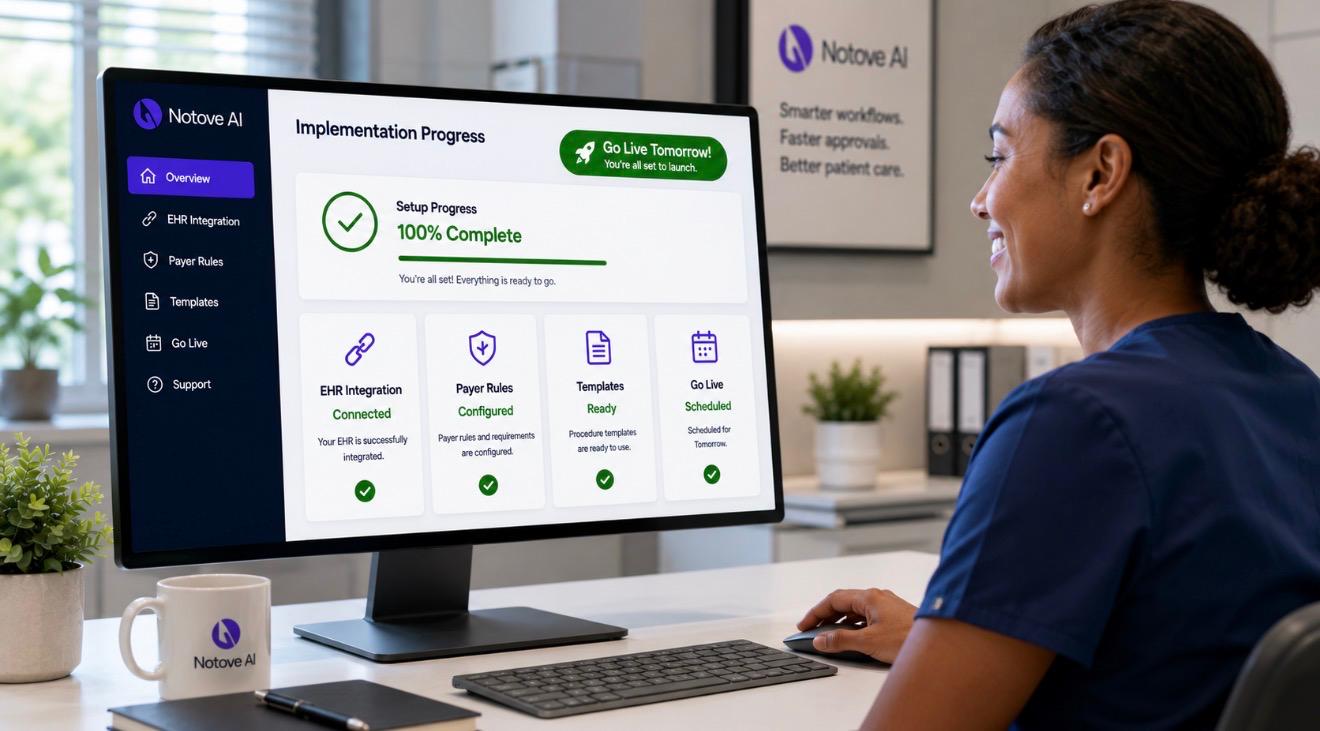
Start narrow with Prior Authorization AI. Pick one specialty workflow or one procedure type first. Prove the return on investment before expanding further. You do not need a technical team to define roles for this rollout. You need a PA lead, a clinical reviewer, one power-user champion, and a compliance point person.
Week one deliverables are simple. Map the current workflow, list required documents, and pick payer targets. Define success metrics and choose a small pilot cohort. Prior Authorization AI tools like Notove are web-based, so there is no installation required.
Step 1: Pick a High-Impact Pilot That Shows ROI Fast
Choose one or two high-volume, high-denial services to start. MRI orders, advanced imaging, and orthopedic injections are strong candidates. Select based on monthly volume, staff minutes per request, and denial rate.
Define what success looks like within thirty days. Faster turnaround, fewer touchpoints, and higher first-pass approvals all count. An MRI PA queue pilot might target cutting processing time in half.
Step 2: Map Your Current PA Workflow in 30 Minutes
Use a lightweight mapping method. Intake, detect PA need, gather evidence, fill forms, submit, follow up, close. Time gets lost hunting for notes and missing imaging reports. Portal re-entry and status checks eat up hours too.
Handoff points between staff create most delays and denials. Standardize those handoffs before your Prior Authorization AI pilot begins. Your deliverable is a one-page workflow with clear owners.
Step 3: Standardize the Documentation Packet (The Real Denial Killer)
Most payer denials come from missing or weak evidence, not clinical appropriateness. This is where Prior Authorization AI earns its keep fastest. Build a pilot evidence checklist covering the essentials. Include recent notes, diagnosis codes, failed conservative therapy, imaging results, and labs.
Payer requirements vary significantly, and packets need to reflect that. A cardiology PA packet looks nothing like an oncology one. The goal is an always-ready PA packet that reduces payer back-and-forth. Documentation requirements shift by payer more than most clinics expect. This guide on AI prior authorization software for small and specialty clinics covers the details.
Step 4: Connect Notove AI to Your Workflow Without an EHR Integration Project
Notove AI works alongside any EHR system, which matters for clinics without IT support. Start with browser-based workflows and controlled document inputs. You can expand integration later if your clinic needs it. Setup takes about five minutes and requires no downloads.
Create an account, define your clinic details, and choose pilot services. Set user roles with least-privilege access between staff and reviewers. A shared inbox and queue model keeps everyone aligned. Before onboarding, gather sample PA requests, payer rules, and denial examples. If your team has questions before starting, you can always reach out to the Notove team directly.
How Notove AI Handles the PA Workflow End to End
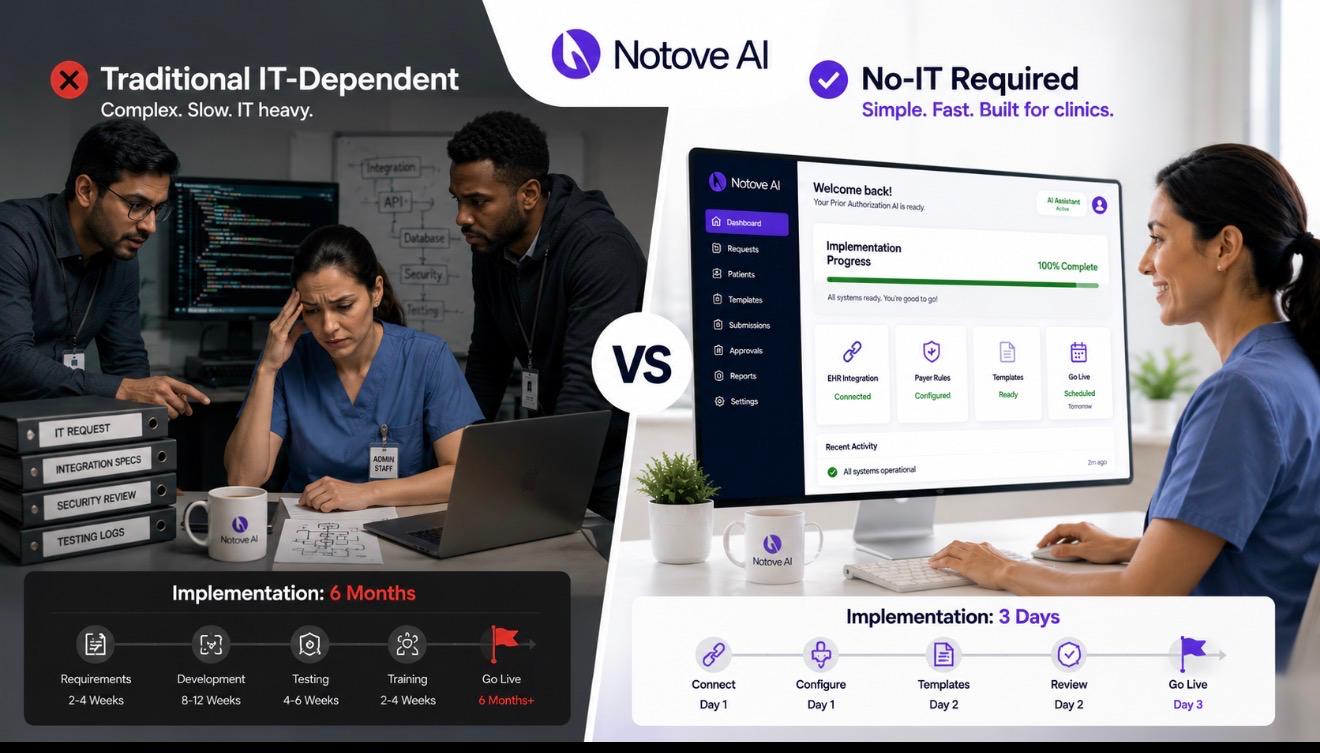
Notove’s Prior Authorization AI follows a five-step loop that staff can learn quickly. Authorization Detection identifies procedures that need prior approval automatically. Documentation Collection gathers clinical evidence from your existing records. Request Preparation drafts payer-specific forms based on that evidence.
Staff Review and Submit puts a human in charge of the final decision. Submission Tracking then monitors approvals, denials, and follow-ups automatically. The AI gathers and drafts, while your staff verifies and submits. Fewer tabs, fewer copy-paste steps, and more consistent packets are the daily result.
Step 5: Set Up Review, Approval, and Compliance Guardrails
Guardrails protect patient safety, billing integrity, and audit readiness. Staff should verify patient identifiers, procedure codes, and medical necessity statements before submission.
HIPAA compliance means encryption, access controls, audit logs, and retention policies. Any Prior Authorization AI vendor should meet these standards without exception. Build a simple SOP defining who approves each request and how denials are handled. Want the full checklist? Review this breakdown of HIPAA compliant prior authorization automation and vendor red flags.
Step 6: Train Staff in 60 Minutes and Get Adoption Without Pushback
Frame this as workflow training, not AI training. A one-hour session should cover the queue overview and packet review process. Add common edits, the submission checklist, and follow-up tracking.
Start with one or two super-users in the clinic. A shared playbook keeps everyone consistent. Celebrate early wins like time saved and approvals granted. Staff should stop manual copy-paste and duplicate status calls immediately.
Step 7: Measure Results That Actually Matter (30-Day Scorecard)
Track metrics that connect directly to time and money. Minutes per PA, touchpoints, and first-pass approval rate matter most. Time-to-approval and resubmission rate round out the picture.
Quantify the return in plain terms. Hours saved per week and reduced overtime both count. Fewer delayed procedures means better patient outcomes too. Run a weekly ops review using your Prior Authorization AI tracking data.
Common Implementation Mistakes and How to Avoid Them
Trying to automate every payer and procedure on day one is the top mistake. Fix this by narrowing the pilot, then expanding gradually. Unclear ownership of the PA queue causes confusion fast. Assign a single accountable PA lead.
Treating AI output as final without review is another common error. A mandatory review checklist solves this. Ignoring denial reason patterns wastes data you already have. Build a denial taxonomy and update your checklist regularly. Lack of status tracking leaves everyone guessing where a PA stands.
Where Notove AI Stands Out
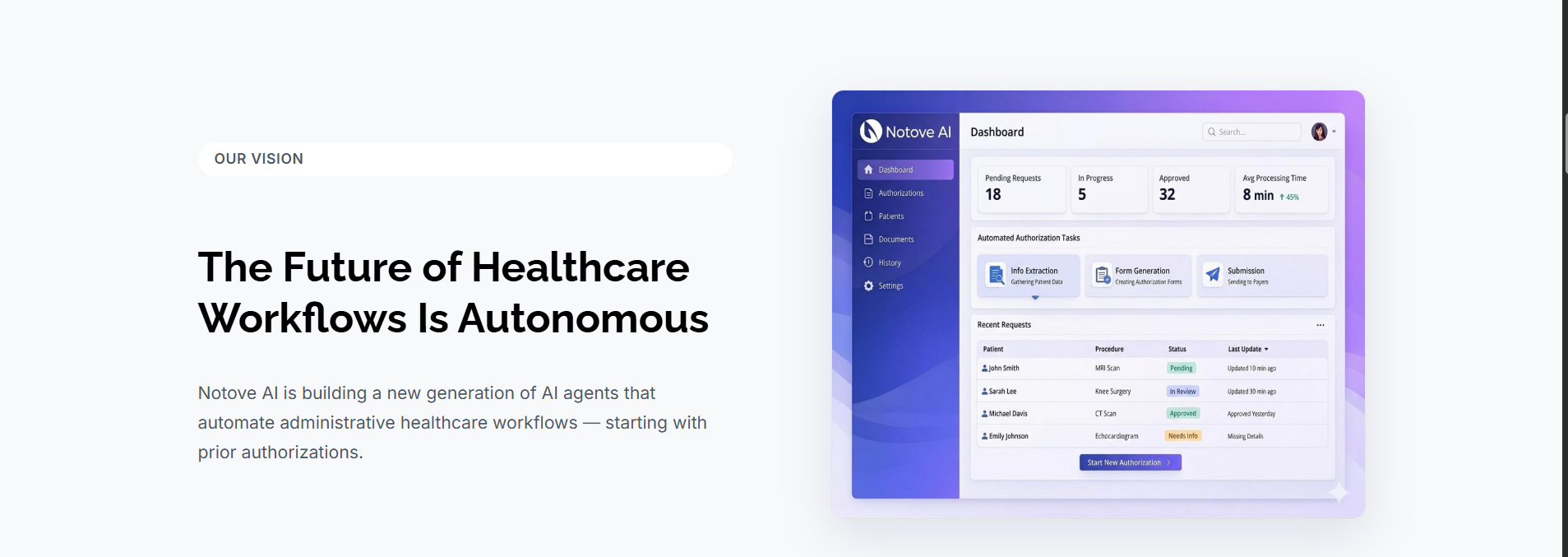
Notove is purpose-built for prior authorizations, not a generic chatbot wearing a healthcare label. The platform is designed to reduce workload by up to 80 percent. It is HIPAA compliant, requires no installation, and takes about five minutes to set up. Submission assistance and tracking come built in from day one.
An AI agent handles repetitive, non-clinical tasks end to end. That is different from tools that only draft a single letter and stop. Still comparing options? This prior authorization software comparison for independent clinics covers what matters in 2026.
A Simple 14-Day Rollout Timeline You Can Copy
Days one and two are for picking your pilot and assigning roles. Days three through five focus on mapping the workflow and building your documentation checklist. Days six and seven are for configuration and test cases. Week two starts your pilot cohort with daily ten-minute huddles. Review metrics weekly and iterate as needed. By day fourteen, you should have enough data to decide on expansion.
Get Early Access to Notove AI
If your clinic wants faster approvals without adding administrative staff, a pilot is the right next step. Prior Authorization AI does not require a technical background or a big budget to start. Early access to Notove includes priority onboarding support and exclusive pricing. Spots are limited to the first 500 physicians for personalized support.
Bring three things to your onboarding session. Your top two payers, your top two procedures needing PA, and five recent PA examples. Visit the Notove AI homepage to join the waitlist and see how a no-IT rollout works for your clinic.
FAQ
What is Prior Authorization AI and how is it different from a rules engine?
Prior Authorization AI refers to software agents that detect PA requirements, gather clinical evidence, and draft payer-specific requests. A rules engine only follows fixed logic and cannot adapt to varied documentation. True PA agents match evidence to payer criteria and learn from denial patterns over time.
Does implementing Prior Authorization AI require an IT team or EHR integration?
No. Most Prior Authorization AI platforms, including Notove, are web-based and require no installation. They work alongside your existing EHR without a full integration project. Setup typically takes about five minutes with a browser and staff logins.
Is Prior Authorization AI HIPAA compliant?
Reputable Prior Authorization AI vendors maintain HIPAA compliance through encryption, access controls, and audit logging. Always confirm these details directly with a vendor before onboarding. Ask specifically about data retention policies and who can access patient information.
How long does it take to see results after adopting Prior Authorization AI?
Most clinics see measurable results within thirty days of a focused pilot. Faster turnaround times and fewer manual touchpoints appear first. First-pass approval rate improvements typically follow once documentation packets are standardized.
Can Prior Authorization AI replace clinical judgment?
No, and it is not designed to. Prior Authorization AI handles repetitive administrative tasks like documentation assembly and form preparation. A human reviewer always verifies and approves before anything is submitted to a payer.
Which procedures benefit most from Prior Authorization AI first?
High-volume, high-denial services see the fastest return. Advanced imaging like MRIs, orthopedic injections, and oncology medications are common starting points. Clinics typically choose one or two services for an initial pilot before expanding further.