

Radiology clinics know this moment well. An MRI or CT is ordered, the patient is ready, and the schedule stalls on a pending authorization. That single delay ripples outward fast. It forces reschedules, wastes scanner time, and leaves patients frustrated before they even arrive. Prior authorization has become one of the biggest operational drags radiology clinics face today, and the pressure is only building.
Why This Bottleneck Keeps Getting Worse for Radiology Clinics
Prior authorization for radiology typically covers advanced imaging, repeated studies, contrast use, and site-of-service rules. Each of these adds another layer of payer scrutiny. Every delayed approval compounds into reschedules, idle scanner time, and growing patient dissatisfaction. For radiology clinics, this is not a minor inconvenience.
The business impact runs deep too. Slower throughput means fewer studies completed per day. Revenue cycle delays follow close behind, along with staff burnout from constant follow-up calls. Patients frustrated with wait times may simply choose a competitor with faster access.
How the Prior Authorization Process Actually Works
The full sequence looks straightforward on paper. Order, benefits verification, PA requirement check, medical necessity documentation, payer form submission, status checks, and approval or denial. Peer-to-peer review sometimes follows if the first request falls short.
Time gets lost at nearly every step along the way. Staff hunt through clinical notes, match payer-specific rules, and re-enter the same data across portals. Phone and fax follow-ups add even more delay to an already slow process.
Every payer and plan brings its own forms and criteria. What works for one insurer often fails for another. Radiology adds extra complexity because volume is high and cases are often time-sensitive. Referring-provider dependencies and modality-specific criteria for MRI, CT, and ultrasound all vary too.
The Most Common Reasons Radiology PAs Get Delayed or Denied

Missing or incomplete documentation is the top reason for denial. History and physical notes, conservative therapy trials, and prior imaging are frequently absent. A mismatch between diagnosis and procedure codes causes trouble too.
Incorrect site-of-service details or NPI and taxonomy errors slow things down further. Duplicate requests, expired authorization windows, and mismatched dates of service all add friction. Unclear clinical rationale from the ordering provider is another common gap.
These denials have real consequences beyond paperwork. Patients face delayed diagnoses and higher no-show rates. Staff get pulled into rework loops that eat into their week.
What “Days to Hours” Really Means for Radiology Clinics
Slow approvals carry a measurable operational cost. Staff spend hours per request, often repeating the same follow-up calls. Every hour a scanner sits idle is lost revenue for radiology clinics.
Patients feel this cost directly too. Longer wait times increase anxiety and raise cancellation rates. Referring physicians may stop sending patients to clinics with a reputation for delays.
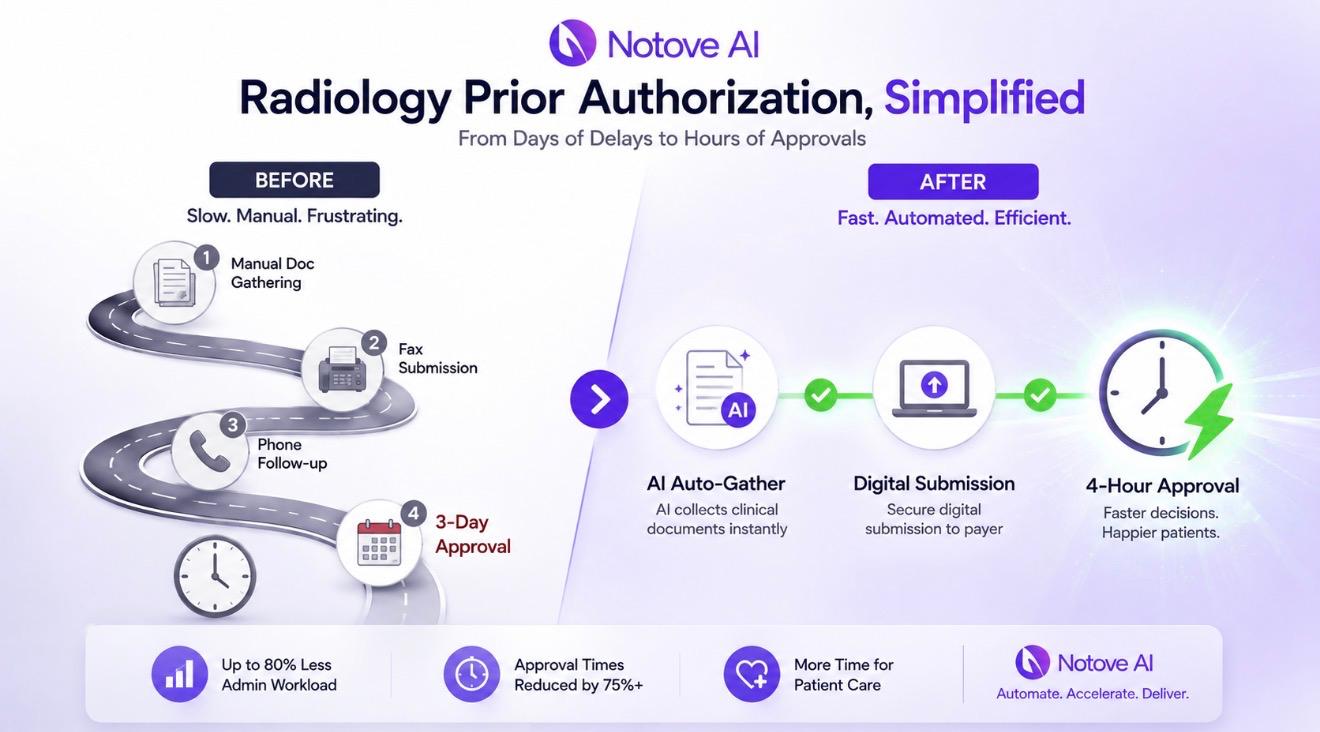
The revenue cycle takes a hit as well. Delayed billing, resubmissions, and write-offs all increase accounts receivable days. A manual PA process might take three to five days per case. A streamlined process can bring that down to hours instead.
Traditional Fixes Radiology Clinics Try (And Why They Only Help a Little)
Hiring more authorization staff helps with volume, but it raises overhead and training time for radiology clinics. Checklists and templates reduce some missed steps, but payer variability still trips teams up.
Outsourcing prior authorization work can improve throughput on paper. It often adds coordination delays and reduces visibility into the process. EHR macros and manual copy-paste routines remain repetitive and error-prone. None of these fixes address the root problem. The bottleneck is repetitive administrative work layered with payer-specific rules, which is exactly what automation solves best.
Where AI Fits Into Prior Authorization for Radiology Clinics
AI belongs in operational automation, not clinical decision-making. That distinction matters for how radiology clinics should think about adoption. The right tasks to automate include PA detection, documentation gathering, form filling, and status tracking.
Some tasks should always stay human. Final review, nuanced clinical judgment, peer-to-peer calls, and escalation decisions belong with staff. Radiology is a particularly strong fit for this kind of automation. Volume is high, criteria are standardized, and data requirements are predictable. Human-in-the-loop review and full auditability keep the process compliant throughout.
How Notove AI Cuts Approval Times from Days to Hours
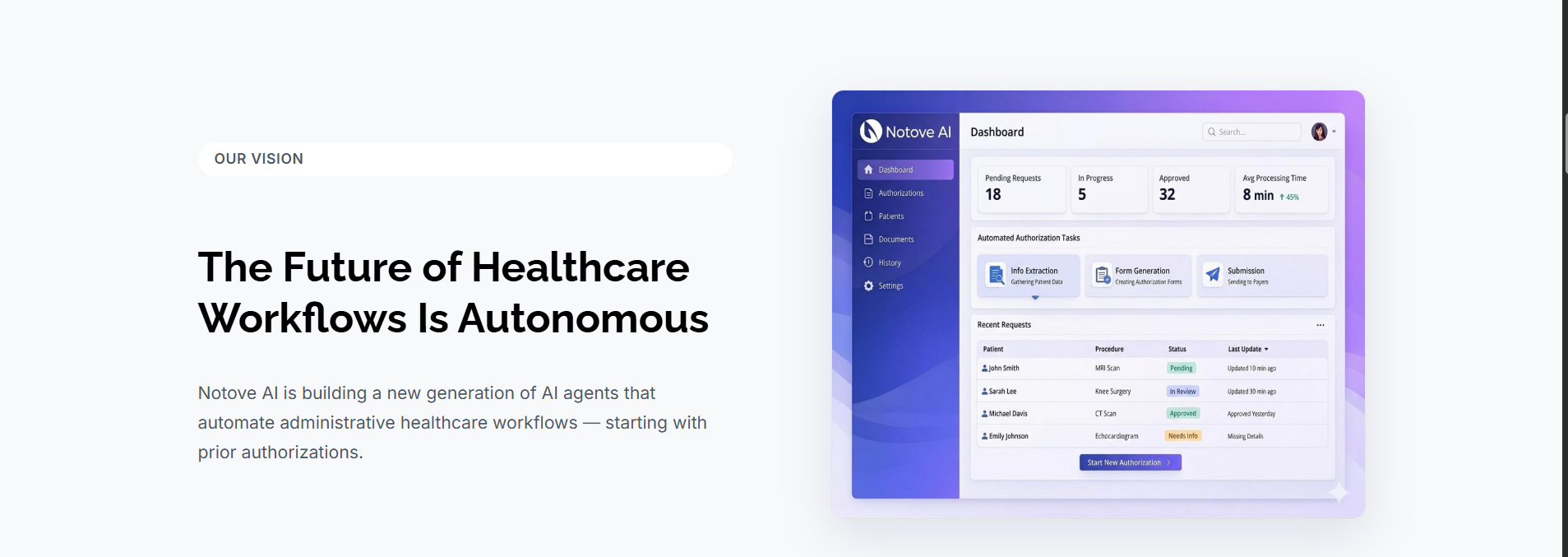
Notove AI is built for clinics that need prior authorization handled faster, including radiology clinics of every size. The workflow follows the same sequence your staff already knows.
Authorization Detection identifies procedures likely to need PA, including MRI, CT, contrast studies, and repeat scans. Documentation Assembly pulls supporting evidence such as symptoms, prior treatments, and imaging history. Request Preparation generates payer-specific forms with medical necessity language already aligned.
Staff Review and Submit puts your team in control of the final decision. Review happens in seconds instead of minutes per request. Submission Tracking then follows every request through to a decision. Deadlines, follow-ups, and outcomes are tracked automatically so nothing slips through.
Fewer back-and-forth loops and fewer missing pieces at first submission are what actually produce the hours-not-days result.
Radiology-Specific Playbook: What to Standardize for MRI and CT Authorizations
Different modalities call for different documentation bundles. Payers expect specific evidence depending on the study type. Building modality-based templates in advance saves significant time later.
A minimum viable evidence set includes symptom duration, neurological red flags, and a conservative care trial. Prior imaging dates and results should always be included as well. Consistent ICD-10 selection matched to the clinical story prevents mismatch denials. CPT codes need to match laterality and contrast use exactly.
| Modality | Core Documentation Needed | Common Denial Trigger |
|---|---|---|
| MRI Spine | Symptom duration, conservative care trial, neuro deficits | Missing conservative therapy history |
| MRI Brain | Neurological symptoms, prior imaging, red flag findings | Vague or missing clinical rationale |
| CT Abdomen/Pelvis | Symptom history, lab findings, prior imaging results | ICD-10 to CPT mismatch |
| CTA | Vascular risk factors, symptom acuity, prior studies | Incorrect contrast or laterality coding |
Notove AI supports this by auto-assembling documentation and tailoring requests per payer. That removes the manual template switching that slows most radiology clinics down.
Implementation Without Disruption: 5-Minute Setup, No Installation
Onboarding is web-based and requires no installation at all. Radiology clinics can fit this directly into their existing workflow. A realistic day looks like this. Orders arrive, Notove flags which ones need PA, staff reviews the prepared packet, and it gets submitted.
Role clarity matters here too. Front desk staff, authorization specialists, and imaging managers each touch a different part of the process. Start with one modality and payer combination before expanding further. Getting started takes no technical support. This guide on how to implement Prior Authorization AI at your clinic with no IT team required walks through it.
Security, Compliance, and Trust: What Radiology Clinics Should Demand
HIPAA compliance is table stakes for any AI tool touching patient data at radiology clinics. Look for encryption, secure data handling, and regular security audits. Human oversight should never be optional either. AI drafts and prepares, but staff reviews before anything is submitted.
An audit trail matters for accountability. Clinics need to know who changed what and when it was submitted. Data minimization is another principle worth demanding. Only the information needed for authorization should be collected or shared. Want vendor evaluation criteria? This guide on HIPAA compliant prior authorization automation covers what to look for.
KPIs to Prove ROI Within 30 Days
Approval turnaround time is the metric that matters most. Track it by payer and by modality separately. First-pass submission completeness rate shows how much rework your team avoids.
Denial rate and denial reason categories reveal where documentation still falls short. Staff time per authorization shows the real labor savings. Many radiology clinics aim for up to 80 percent workload reduction. Scheduling metrics matter too, including reschedules and no-show rates tied to auth delays.
Reviewing this data weekly keeps the pilot on track. Curious about the time savings? This piece on how clinics reclaim 10 hours per week breaks down the numbers.
How Notove AI Stands Out From Generic Automation Tools
Rule-only tools and generic AI chatbots were not built for healthcare admin work. Notove was designed specifically for payer-specific preparation from day one. The platform behaves like a full agent, not a form filler.
It detects, gathers, prepares, assists with submission, and tracks outcomes end to end. Radiology clinics get fast setup, no installation, and a staff-led review process throughout. The outcome is fewer denials, faster approvals, and reclaimed hours every week. If you are still weighing your options, this prior authorization software comparison for independent clinics is worth reading first.
Get Started: A Simple 3-Step Rollout Plan for Radiology Clinics
Start by picking your highest-friction area. MRI spine cases with your top two payers is a common starting point. Define your success metrics before you begin.
Run parallel for one week. Compare Notove-prepared packets against your manual process on turnaround and rework. Once results look strong, expand coverage to more modalities and payers. Add more staff roles and set a weekly KPI review cadence.
Radiology clinics that make this shift reclaim staff hours, reduce denials, and get patients scheduled faster. Visit the Notove AI homepage to request early access and see how a days-to-hours approval process works for your clinic.
FAQ
How long does prior authorization typically take for radiology procedures?
Manual prior authorization for MRI or CT scans often takes three to five business days. Complex cases requiring peer-to-peer review can take longer. AI-assisted preparation can reduce this to hours by eliminating documentation delays and resubmission cycles.
What information do payers require for MRI or CT prior authorization?
Payers typically require symptom duration, conservative treatment history, and prior imaging results. Diagnosis codes must align with the requested procedure. Neurological red flags or acute findings often need to be documented explicitly as well.
Can AI replace clinical judgment in radiology prior authorization?
No. AI handles administrative tasks like documentation gathering and form preparation. Clinical judgment, peer-to-peer calls, and final submission decisions remain with trained staff. Human review is a required step before any request goes to a payer.
Why do radiology prior authorizations get denied more often than other specialties?
Radiology involves high-cost, high-volume procedures with strict payer criteria. Modality-specific documentation requirements vary between MRI, CT, and ultrasound studies. Missing conservative therapy history or code mismatches are the most frequent denial triggers.
Is AI-assisted prior authorization software HIPAA compliant?
Reputable platforms maintain HIPAA compliance through encryption, access controls, and audit logging. Always confirm data handling practices directly with a vendor. Human-in-the-loop review should remain part of any compliant workflow.
How quickly can a radiology clinic start using Prior Authorization AI?
Most platforms require no installation and can be set up within about five minutes. Clinics typically start with one modality and payer combination before expanding. A focused pilot can show measurable results within thirty days.