

Prior authorization for primary care has become one of the biggest time drains in modern medicine. A physician orders an MRI or a new medication, and suddenly the visit turns into a paperwork project. Front desk staff spend hours chasing payer portals. Patients wait, get frustrated, and sometimes give up on care altogether. This guide walks through exactly why that happens, what payers actually require, and how a repeatable workflow (with the right automation) can turn prior authorization from a daily headache into a manageable process.
Why Prior Authorization for Primary Care Is Such a Bottleneck
Primary care runs on volume. Visits are short, schedules are packed, and administrative time is limited. Meanwhile, payers keep adding more services to their prior authorization lists. That combination creates constant friction.
It helps to separate the terms first. A referral sends a patient to another provider. Precertification confirms coverage before a service happens. Medical necessity review checks whether the service fits a payer’s clinical criteria. Prior authorization for primary care often overlaps with all three, which is exactly why it feels confusing.
Most delays and denials trace back to a handful of causes. Missing clinical criteria is the most common one. Mismatched diagnosis and procedure codes come next. Outdated payer rules, incomplete chart notes, and thin documentation of conservative treatment also show up often. Step therapy proof and site-of-service restrictions round out the list.
Specialty clinics deal with one payer type and a narrow set of procedures. Primary care deals with dozens of conditions, multiple payers, and constantly shifting requirements, usually without a dedicated authorization team. The goal of this guide is simple. Fewer denials, faster approvals, and a workflow your staff can actually follow every day.
What Typically Requires Prior Authorization for Primary Care
Certain categories trigger prior authorization more than others. Advanced imaging like MRI and CT scans almost always need it. Sleep studies, durable medical equipment, and high-cost medications or biologics are close behind. Some genetic tests, physical therapy beyond a set number of visits, injections, and outpatient procedures also make the list.
Payers apply these rules for a few reasons. High cost drives scrutiny. So does high utilization, wide variability in how a service gets used, and safety monitoring for certain drug classes. Specialty medications get extra attention because of both price and risk.
A few real examples make this clearer. An MRI ordered for chronic low back pain will almost certainly need prior authorization. GLP-1 medications for weight management usually require it too. Continuous glucose monitors and sleep apnea testing follow the same pattern. Requirements vary by payer and plan, so confirming benefits before submission always saves time later.
Before You Submit: A 10-Minute Pre-Check That Prevents Most Denials
A short pre-check before submission catches most of the problems that lead to denials down the line. Start with eligibility and benefits verification. Confirm active coverage, plan type, and that the member ID is correct.
Next, confirm the actual authorization pathway. Some payers use a portal, others use fax, and many route through a vendor like AIM, EviCore, or TurningPoint. Decide whether the request is standard or expedited at this stage.
Pull the specific clinical criteria for that payer and procedure before writing anything. Save the policy document or a link to it directly in the case file. Check the timing rules too, including retro-authorization policy, service date windows, and how long an approval stays valid once granted.
It also helps to have a short script ready for patients. Explain what prior authorization for primary care actually means, roughly how long it takes, and what happens if the request gets denied. A standardized intake checklist for staff turns this whole pre-check into a five-minute habit instead of a guessing game.
Step-by-Step: The Prior Authorization for Primary Care Workflow

Once the order is placed, the real workflow begins. Here is how it should move from request to approval.
The process starts with capturing exact details. Record the CPT or HCPCS code, the ICD-10 diagnosis, the site of service, and the requested dates. Small errors here cause big delays later.
Next comes the clinical story. Write one clear paragraph covering symptoms, duration, red flags, functional impact, and relevant exam findings. Avoid vague language completely.
Conservative treatment proof comes after that. List medications tried, physical therapy or home exercise attempts, activity modifications, and how the patient responded. Note any contraindications if they apply.
Objective evidence should follow immediately. Include prior labs, imaging results, vital signs, and screening tools like PHQ-9 or STOP-BANG where relevant. Tie each piece directly to the payer’s stated criteria.
From there, submit the payer-specific form and double-check that every field matches the chart. Track the status on a set cadence, such as a day one confirmation, a day three follow-up, and a day seven escalation if nothing has moved.
If a peer-to-peer review gets requested, prepare a sixty-second clinical summary in advance. Once approval comes through, document the authorization number, valid dates, and approved units, then notify the patient and facility. If the request gets denied instead, move straight into the denial workflow covered later in this guide.
What Payers Actually Look For in Documentation
Every payer policy works like a checklist behind the scenes. Your documentation has to explicitly satisfy each item on that checklist, not just describe the patient’s condition in general terms.
The elements that show up again and again include diagnosis specificity, symptom duration, and severity or functional impairment. Documented failed conservative therapy with actual dates matters just as much. Contraindications, exam findings, risk factors, and prior test results round out what payers expect to see.
Different scenarios call for different details. Imaging requests for back pain or headache need red flag symptoms, neurological deficits, and prior conservative treatment clearly noted. Sleep study requests need STOP-BANG or Epworth scores along with comorbidities. GLP-1 and anti-obesity medication requests need BMI, comorbidities, and documented lifestyle program participation. CGM requests need diabetes type, insulin regimen, and hypoglycemia history. DME requests need a clear functional limitation and prior alternatives that were tried first.
The most common silent denial cause is a vague note. A line like “pain, order MRI” gives a payer nothing to approve against. Specificity is what actually moves a request from pending to approved.
Coding and Data Accuracy Behind Every Clean Request
Even a well-documented request can get denied over small data errors. ICD-10 specificity matters here, including laterality and chronicity where the payer policy requires that level of detail.
CPT and HCPCS codes need to align exactly with the requested service, including correct modifiers, units, and frequency. Rendering provider and billing provider information needs to match across every document submitted.
Date logic causes more denials than people expect. Onset dates, prior treatment dates, and requested service dates all need to fall within the authorization window the payer expects. Clearly labeled attachments, like “PT notes six weeks” or “A1c trend,” also reduce back-and-forth with reviewers.
A short coding double-check before submission, done consistently, prevents a surprising number of avoidable denials.
Denials in Primary Care: Top Reasons and How to Fix Each One
Most denials fall into a short list of categories, and each one has a specific fix. The table below breaks down the most common reasons clinics see.
| Denial Reason | Evidence Needed | Action to Take |
|---|---|---|
| Missing information | Specific missing item identified | Resubmit same day with a complete packet |
| Not medically necessary | Documentation matching payer criteria | Add evidence or consider an alternative pathway |
| Step therapy not met | Prior drug trials, intolerance, or contraindication | Include pharmacy fill history and resubmit |
| Wrong code or service mismatch | Corrected CPT, HCPCS, or ICD-10 pointers | Correct and resubmit immediately |
| Out-of-network or site-of-service issue | Documented access barrier | Switch facility or request an exception |
| Duplicate or expired authorization | Confirmed active authorization dates | Update dates and units, then resubmit |
Peer-to-peer calls work best when the right person makes them. A clinician should handle clinical questions, while staff can manage logistics. Prepare a short summary in advance and document the outcome immediately after the call.
Appeals move through levels, starting with reconsideration, then a formal appeal, then external review if needed. Deadlines are strict, so track them the same way you track the original submission.
Speed Matters: Faster Approvals Without Cutting Corners
Submitting within twenty-four hours of the order cuts down on back-and-forth significantly. Standardized templates for imaging, sleep studies, DME, diabetes technology, and GLP-1s keep every submission criteria-driven from the start.
A complete packet should include the clinical note, problem list, medication history, relevant results, and prior therapy notes together. Choose expedited review only when it is genuinely justified, and document that urgency clearly.
Keeping a quick-reference sheet of payer rules, updated monthly, saves significant time across a busy clinic. Automated status tracking and escalation reminders keep requests from quietly stalling out. A consistent patient communication cadence also cuts down on inbound calls asking for updates.
How Notove AI Fits Into Prior Authorization for Primary Care
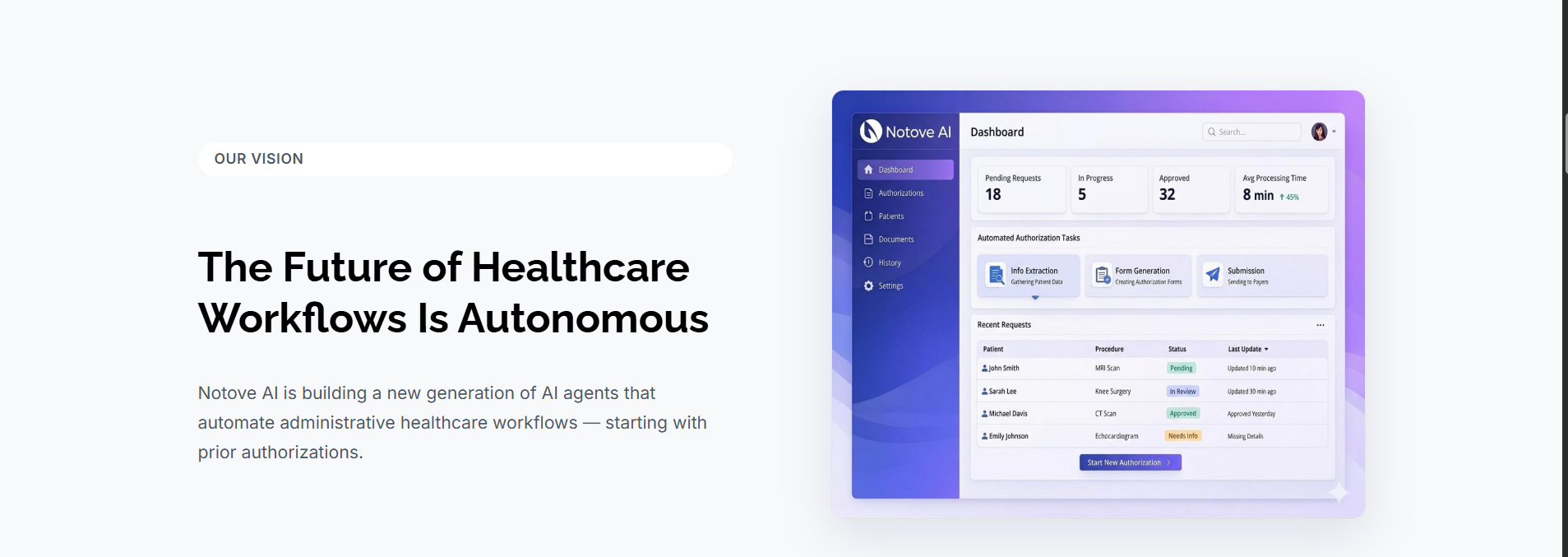
This is exactly the workflow Notove AI was built to support. Instead of staff manually tracking every step above, Notove’s AI agents handle the repetitive parts of prior authorization for primary care from start to finish.
The platform follows a clear sequence. Authorization detection identifies which procedures actually need prior approval. Documentation collection pulls relevant clinical evidence directly from EHR context. Request preparation assembles a payer-specific packet automatically. Staff then review and submit in minutes, with full visibility into submission tracking after that.
Clinics using this kind of automation report meaningfully less staff time spent per request, fewer denials tied to missing information, and faster turnaround overall. It works alongside any EHR, requires no installation, and takes about five minutes to set up. Every request still goes through human review before submission, so clinical oversight never gets removed from the process.
The same underlying approach is already reshaping how modern prior authorization tools are transforming specialty clinics in 2026, and it explains why AI agents are replacing manual prior authorization staff at independent practices. Oncology teams are seeing similar results with prior authorization automation for oncology, where delays carry higher stakes. Radiology groups are seeing the clearest speed gains, with prior authorization for radiology clinics cutting approval times from days to hours.
Implementation Checklist for Clinics: A PA-Ready Workflow in Two Weeks
Getting started does not require a full department overhaul. Begin by defining roles. Someone needs to own intake, even part-time, and a clinician should be designated for peer-to-peer calls.
Build a few core artifacts next. A PA intake checklist, criteria-driven templates, a denial playbook, and a payer reference sheet cover most of what a clinic needs day to day.
Set clear service-level agreements. Submission within twenty-four hours, a defined follow-up schedule, and specific escalation triggers keep requests from stalling silently. Track a handful of metrics too, including time-to-submit, time-to-decision, denial rate by reason, and staff minutes spent per request.
This is where automation earns its place. Detection, packet assembly, form preparation, and tracking can run in the background while clinicians keep final oversight. Throughout all of this, HIPAA compliance, minimum necessary access, and clear audit trails need to stay non-negotiable.
Prior authorization for primary care does not have to drain your team’s time every single day. A structured pre-check, a repeatable submission process, and clean documentation solve most of the problem on their own. Automation solves the rest. If your clinic is ready to spend less time on paperwork and more time with patients, visit Notove AI to see how the platform works, or join the waitlist to get early access.
FAQ
What is prior authorization for primary care and why does it matter?
Prior authorization for primary care is the approval a payer requires before covering certain services ordered by a primary care provider. It matters because it directly affects how quickly patients get imaging, medications, or equipment they need. Without it, claims can be denied even when the care was appropriate.
How long does prior authorization for primary care usually take?
Standard requests typically take anywhere from a few days to about two weeks, depending on the payer and the service requested. Expedited requests, when justified and documented properly, can move much faster. Incomplete documentation is the most common cause of longer delays.
What is the fastest way to reduce prior authorization denials in a primary care clinic?
Submitting complete documentation on the first attempt is the single biggest factor. That means matching diagnosis codes to procedure codes, documenting conservative treatment with dates, and confirming payer-specific criteria before submission. A short pre-check process catches most issues before they cause a denial.
Can AI actually help with prior authorization for primary care?
Yes. AI tools can detect which orders require authorization, pull relevant documentation from the EHR, and assemble payer-specific request packets automatically. Staff still review and submit each request, which keeps clinical oversight intact while cutting down the manual workload significantly.
What happens if a prior authorization request gets denied?
Denials fall into categories like missing information, medical necessity disputes, or step therapy issues, and each has a specific fix. Clinics can often correct and resubmit the same day for coding or documentation errors. More complex denials may require a peer-to-peer call or a formal appeal.
Does prior authorization for primary care differ from specialty care requirements?
Yes, primary care providers deal with a much broader mix of conditions, payers, and requirements compared to specialty clinics that usually work with one payer type and a narrower set of procedures. This makes standardized templates and centralized payer rules especially valuable for primary care teams.